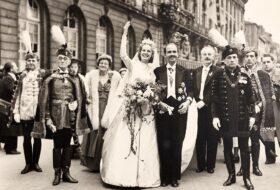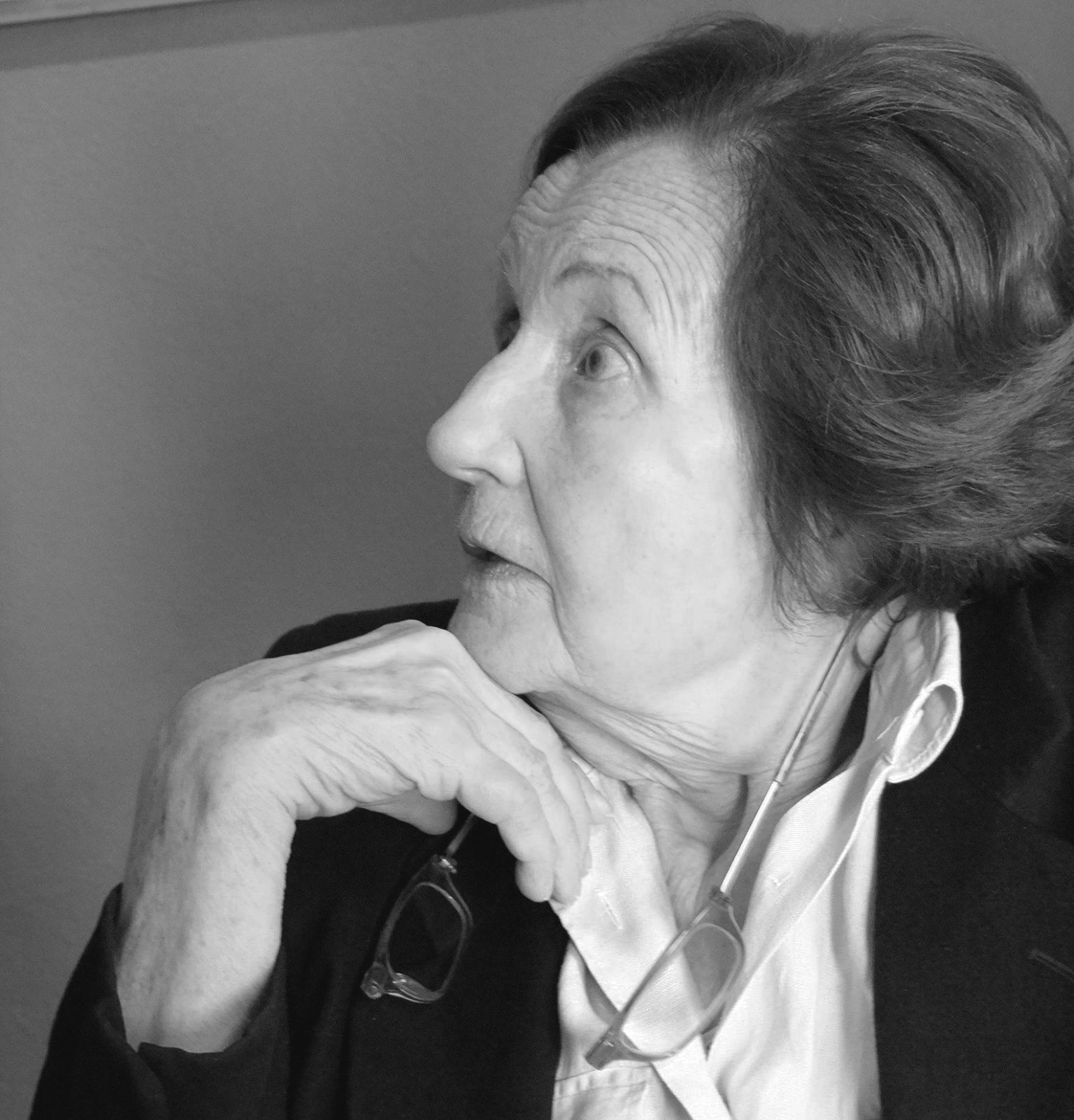
The above quote is from Alice Esterházy-Malfatti’s letter of 28 November 1990, addressed to Otto von Habsburg. The daughter of the martyred Hungarian politician from Slovakia reports on her journey across Upper Hungary and encloses the recently published biography of her father (Gabor Szent-Ivany: Count Janos Esterhazy. The Life and Works of the Great Son of the Hungarian Highland, transl. László Dósa, Danubian Press, Astor, Fla., 1989).
There is no doubt that our namesake honoured the request expressed in those lines. On numerous occasions, he raised his voice on behalf of Hungarians living as a minority; he repeatedly criticised the Slovak language law and the discriminatory measures of the Mečiar government. He closely followed the issue of the rehabilitation of János Esterházy (1901–1957) and, in 1995, wrote the preface to the German-language publication commemorating him. There we read: „In our tumultuous century, a century that turned into a catastrophe for millions, only a few possessed the steadfast character, noble soul and courage, as well as the foresight to assess the real dangers and to oppose the mainstream with what they regarded as right and just. Count János Esterházy was among them (…), thanks to his profound faith, he acted in the spirit of Christian charity on behalf of all who were persecuted by totalitarianism, without distinction. He was the sole member of the Slovak Parliament who refused to vote for the anti-Jewish laws, and he kept the Hungarians entrusted to him away from right-wing extremism with his now-famous words: ‘Our symbol is the Cross, not the swastika.’“ (Szent-Ivány, Gábor: Graf János Esterházy. Führer der ungarischen Minderheit und das Schicksal der Ungarn in der Tschechoslowakei/Slowakei nach dem Ersten Weltkrieg, ed. Alice Esterházy-Malfatti, Böhlau, Vienna–Cologne–Weimar, 1995, p. 13 — translated by the author of this article.)
The correspondence preserved in our collection provides a clear record of how Alice Esterházy-Malfatti informed Otto von Habsburg of her efforts to advance the discovery of her father’s final resting place and his rehabilitation. At the same time, she never failed to mention the traditionally good relations between the Galánta branch of the Esterházy family and the dynasty: “My grandmother, Countess Erzsébet Tarnowska, was a devoted supporter of the Royal House. When Colonel Ostenburg organised military units for King Charles’s second return, my grandmother sacrificed 50 acres of vineyards in Mád (Tokaj). Her underage children, János and Lujza, awaited the King at Sopron and accompanied him on the train as far as Tata. My aunt became an ad hoc ‘lady-in-waiting’ on the train.” (9 May 2005)
In his letter of thanks dated 13 May 2005, Otto concludes: “Most of all, I am glad that you are doing so much, and with such dynamism, on behalf of Count János Esterházy, which justifies the hope that you will succeed. In any case, I wish you all the best in this endeavour.”
The remains were uncovered in 2007 in Prague, in the Motol Cemetery, to the considerable credit of Karel Schwarzenberg, the Czech Minister of Foreign Affairs and later presidential candidate, and an old friend of Otto von Habsburg.
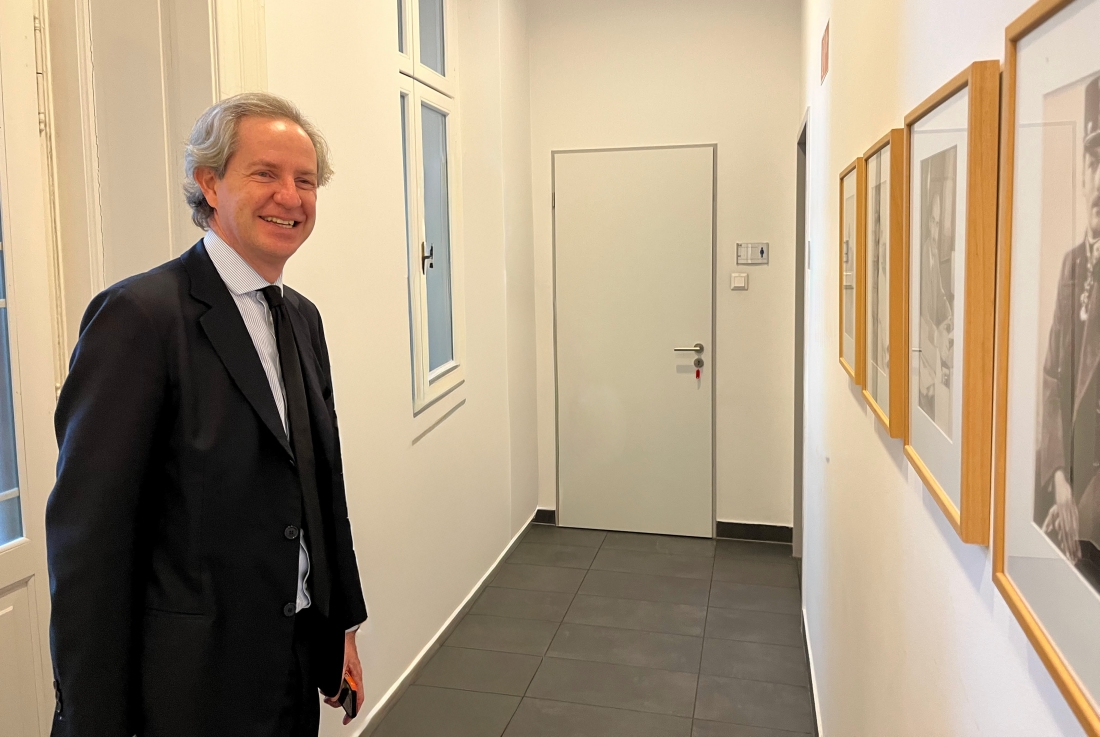
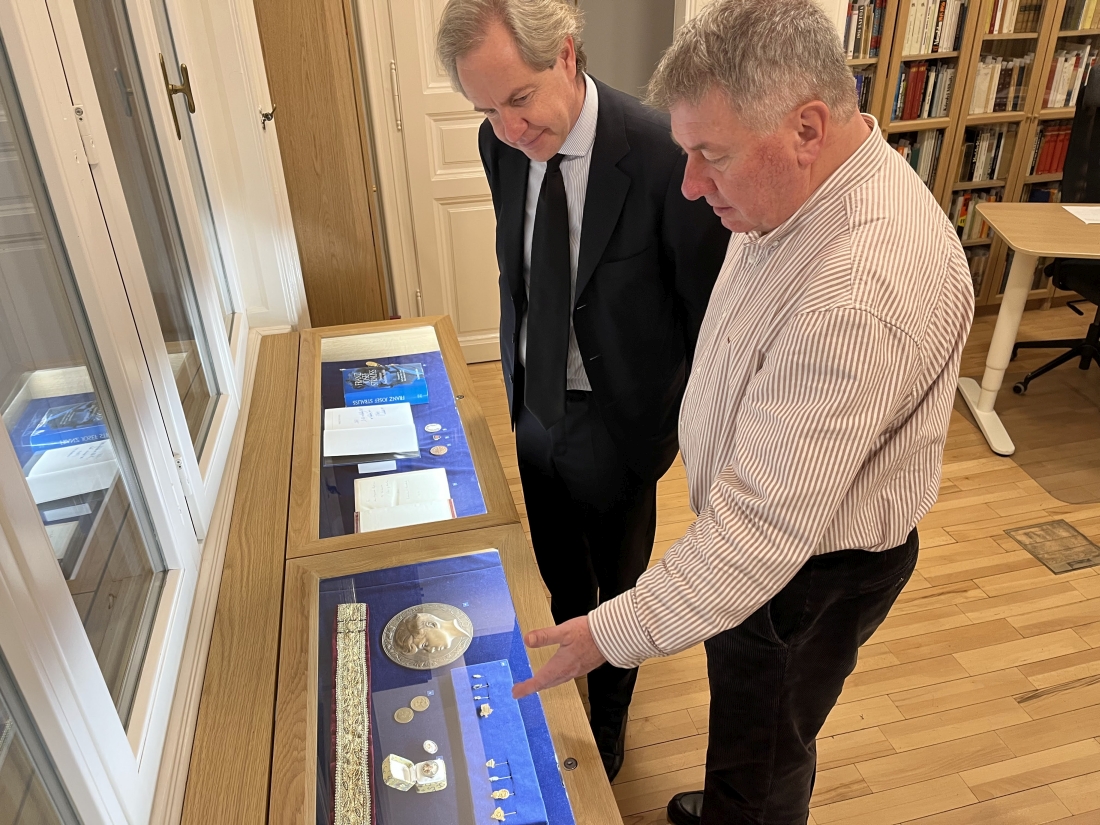
On 20 November 2025, the anniversary of Otto von Habsburg’s birth, the eventful and “dynamic” life of Alice Esterházy came to an end. Her son, Roberto Malfatti, travelled to Budapest for the memorial Requiem Mass held in her honour and, in light of the long-standing friendship, visited our Foundation as well.
It is worth recalling the unusual background of this old friendship. In 1991, the memoirs of Lujza Esterházy (1899–1966), János’s sister, were published by Püski Publishing under the title Szívek az ár ellen (Hearts Against the Tide). The work was translated from the original French into Hungarian by my grandfather’s second wife — something of a surrogate grandmother to me — Éva Samarjay (Mrs Henrik Prőhle, 1916–2015). Born into a bourgeois family in Bratislava and speaking six languages, Aunt Évi was a respected foreign-language correspondent at Chemolimpex when she received the commission from Alice Esterházy-Malfatti.
Their acquaintance dated back to 1939, when Samarjay Éva returned from the United States — where she had perfected her English while caring for children — and became the typist of the United Hungarian Party led by János Esterházy. From 1940 onwards, she took over the French and English education of Alice and her slightly older brother on the family estate at Nyitraújlak. Their connection did not break after 1945, and when Alice, leaving behind internment and work in a bristle factory, eventually defected in 1955 under adventurous circumstances, completed her university studies, found employment at the International Atomic Energy Agency, and later, in 1970, married, the two maintained regular correspondence — and later telephone conversations — within the political and technical confines of the socialist era.
“Aliszka” was always present in our family stories; thanks to the regime change, personal encounters once again became more frequent. Éva Samarjay agreed to translate the book, yet in her foreword to the memoir, she did not conceal her doubts concerning the purpose of the undertaking: “At first reading (…) my impression was that we were indeed late with this if the book is intended, as Alice wished, for publication. Where now are those Frenchmen whom we must win over to our cause at the Paris Peace Conference, to whom we must explain where we come from and why, in a thousand years, we have been unable to forge amicable relations with those with whom we share a common roof. If I were to translate this text, would we Hungarians truly need an explanation of our own history? On the other hand, if I omit the historical parts, would a mere biography suffice? But then again, isn’t this all what today’s youth need, given how much must be made up for after decades of suppression? And in a world of resurgent nationalism, isn’t it timely to strive for forgiveness and reconciliation, to which Lujza Esterházy dedicated her life?” Much has been achieved in recent years in the matter of János Esterházy’s rehabilitation, yet the “efforts of forgiveness and reconciliation” has not yet brought us to the point where his memory receives in Slovakia the recognition it deserves.
Alongside her steadfast struggle for her father’s vindication, Alice Esterházy-Malfatti remained a well-informed follower of Hungarian and European public affairs throughout her life. The memory of her elegant, lively and gracious personality will stay with us.
May God rest her soul!
Gergely Prőhle