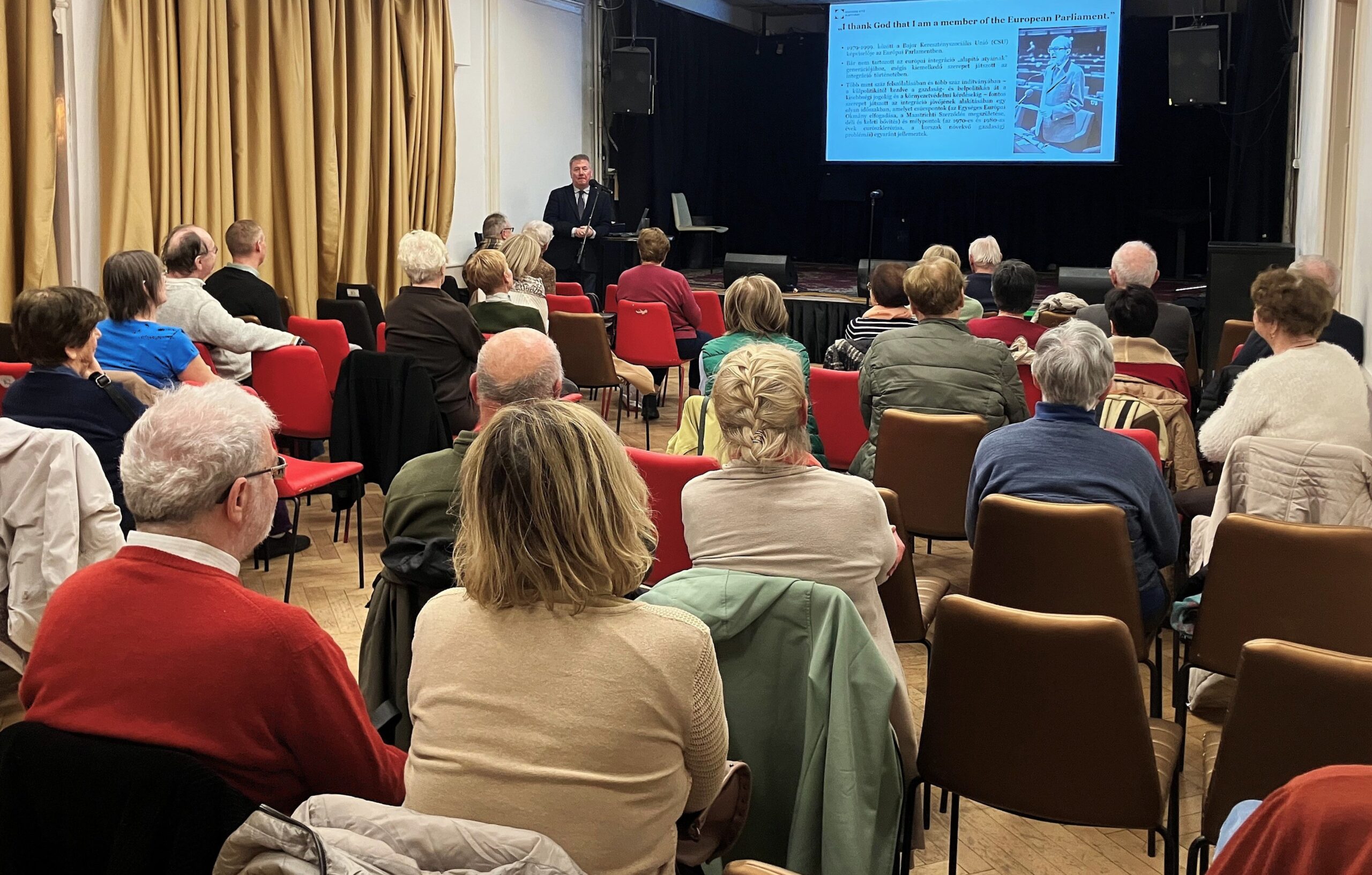
The Kossuth Club – one of Budapest’s long-established venues for public and intellectual discourse, operated by the Tudományos Ismeretterjesztő Társulat (Scientific Education Society) – has for decades served as an important forum for lectures, regularly hosting educational and cultural events.
In his introductory remarks, Béla Kálóczy, the dedicated organizer of the lecture series Napjaink tudományos életéből (From Today’s Scientific Life), a program presenting topics from contemporary scientific and intellectual life), placed the talk in a broader historical context. As he wrote:
“Hungarian history is fascinating. We have always fought against some external enemy, embarked on campaigns abroad, assisted foreign rulers, or taken up arms for our freedom. This went on for centuries. Then, in the 19th century, we reconciled and reached a compromise, and for nearly 50 years we did not have to confront anyone. The country began to flourish as never before. There were neither external nor internal enemies, nor rebels. Yet the outcome was not favorable: we lost a large part of our country, we greeted our anointed king with gunfire, and we attempted to stand on our own feet.
This era produced a remarkable figure whose life spanned nearly a century. He was a crown prince, an exile from his homeland, a Member of the European Parliament, and a diplomat. Although he was not born within our borders, he mastered the Hungarian language – and moreover, for years he represented Hungarian interests in international forums.”
Gergely Prőhle’s lecture focused on how Otto von Habsburg’s political legacy can be interpreted today. He highlighted our namesake’s commitment to European integration, Christian-inspired politics, and cooperation among nations, as well as his leadership role in the Pan-European Union and his work in the European Parliament. The lecture also emphasized that Otto von Habsburg envisioned Europe as a community built on shared intellectual and spiritual foundations, with particular attention to Central Europe and to a subsidiarity-based structure of the continent – an approach that remains highly relevant today.