The scene is Strasbourg, 1988, and the cast is splendid: Pope John Paul II, a radical Protestant minister from Northern Ireland, and the son of Austria-Hungary’s last ruler. The incident became an urban legend, repeated in newspaper articles, blogs, and memoirs. But did Otto actually slap him? Our investigation drew on contemporary press coverage, Otto’s recollections, and the surviving European Parliament footage.
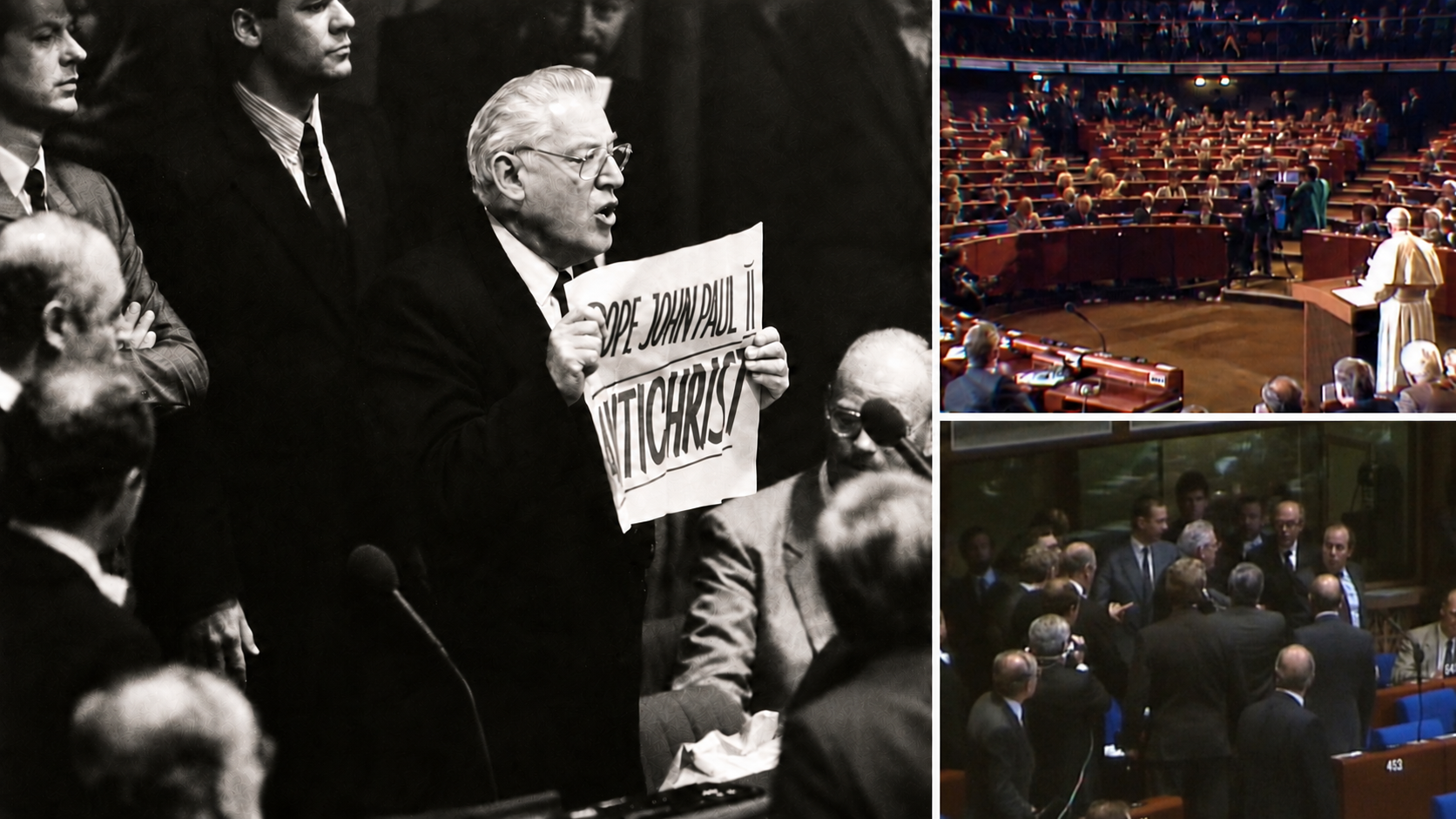
On 11 October 1988, John Paul II addressed the European Parliament in Strasbourg on Europe’s Christian heritage, overcoming the continent’s divisions, and deepening integration. He had barely begun when Ian Paisley, a Northern Irish clergyman and MEP, rose at the back of the chamber, loudly denounced the Pope as the Antichrist, and held up a placard bearing the same accusation. This was a political protest with an unmistakable sectarian dimension, but to call it a religious war would be an exaggeration. Presiding over the sitting was Henry Plumb, Parliament’s president, a British Conservative and political heavyweight. He called Paisley to order and, when the shouting continued, excluded him from the sitting. Members and ushers intervened, seized his sign, and, amid flying sheets of paper and a brief scuffle, escorted him out. The Pope waited calmly for the interlude to end, then resumed his address to a round of applause.
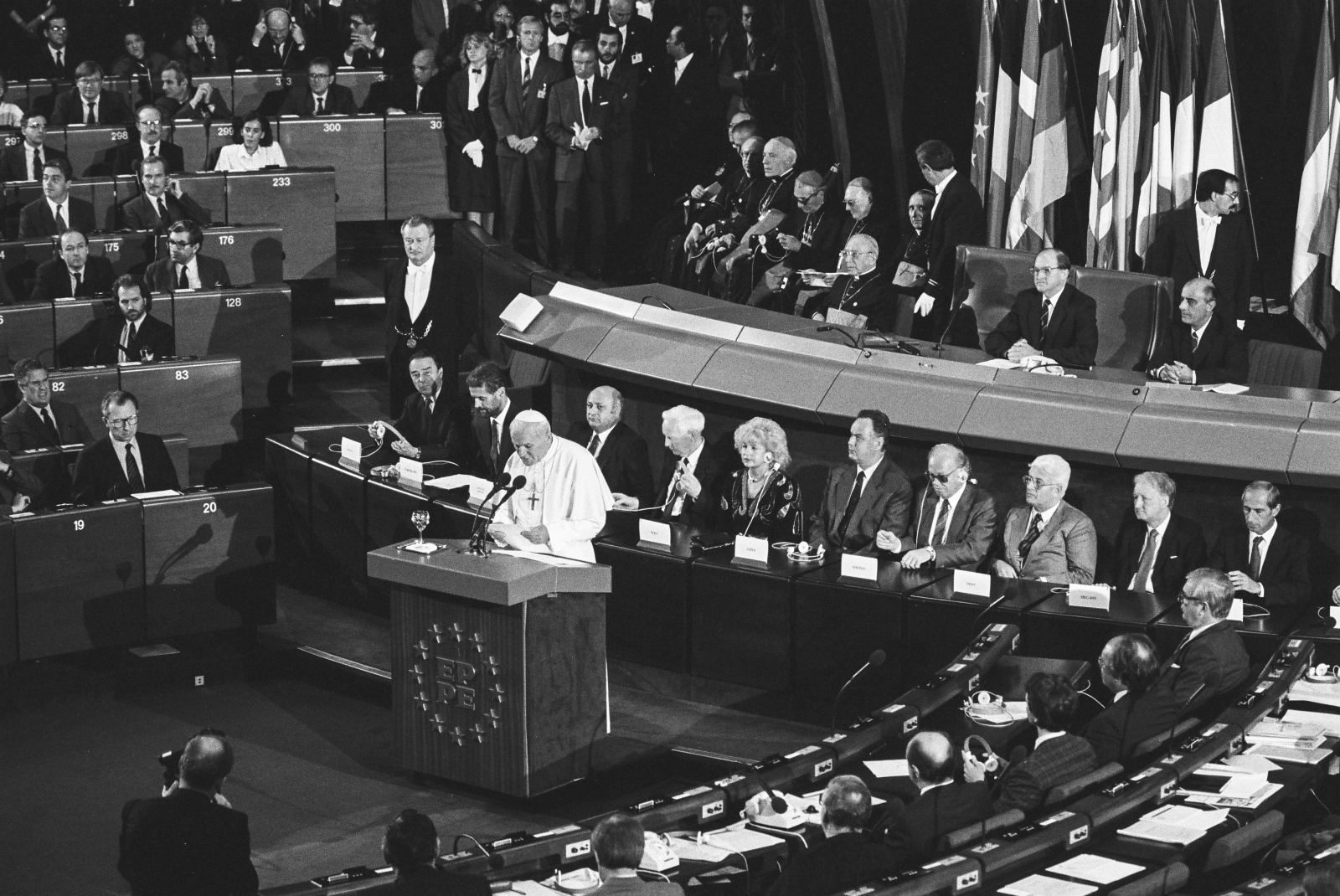 John Paul II in the European Parliament chamber. Ian Paisley’s protest prompted several MEPs to step in. Photograph: European Parliament, Multimedia Centre, 1988.
At a press conference afterwards, Paisley alleged that Catholic MEPs had assaulted him. According to Reuters’ report that day, he complained of being hit; Time later quoted him as saying that he had been punched and severely beaten. Plumb subsequently expressed regret that members had taken matters into their own hands, while questioning whether Paisley had been treated as roughly as he maintained. The minutes of 11 October record his exclusion for disrupting the sitting, but give no details of who may have struck him or how. None of the contemporary accounts named Otto von Habsburg as the assailant. Le Monde identified Bernard Antony as the member who rushed towards Paisley to hit him, but did not say whether the blow landed.
Otto acknowledged his part in Paisley’s removal. In a statement dated 1 November 1988, he wrote that the official response had been too slow, so he and several colleagues had taken away the posters and forced him to leave. He nevertheless rejected the allegation against him: “Paisley claimed that I hit him in the process. That is not true. It was another colleague who delivered the well-deserved blow. I did, however, help to throw him out.” Almost twenty years later, Otto recalled that three French members had joined him in seizing Paisley and leading him away. This had been no easy task, he remarked, given the man’s considerable size.
The European Parliament’s official video archive preserves both the speech and the disturbance. The footage shows Paisley holding his placard at the back of the chamber as people nearby stand up or turn round. White sheets of paper fly towards him, and Otto hurries over to the group already assembled there. This is no uninterrupted broadcast of a boxing match: the camera repeatedly cuts away, leaving parts of the scuffle unseen. When Paisley reappears, he is surrounded. Otto stands close by, facing him and speaking with evident anger. Another member then seems to throw an object in red wrapping paper at Paisley, but misses. Later, Otto and those beside him appear to reach for something in Paisley’s hands. The gesture suggests an attempt to take the placard rather than to strike him.
The recording broadly corroborates Otto’s account of helping to remove his shouting colleague. Although the camera does not capture every moment, it provides no convincing evidence that he resorted to violence. A blow outside its field of view cannot, however, be ruled out entirely.
Taken together, the sources establish Otto von Habsburg’s involvement in the altercation, but suggest that he did not deliver the infamous slap attributed to him.
The full article in Hungarian can be read on Ujkor.hu.
Szilveszter Dékány