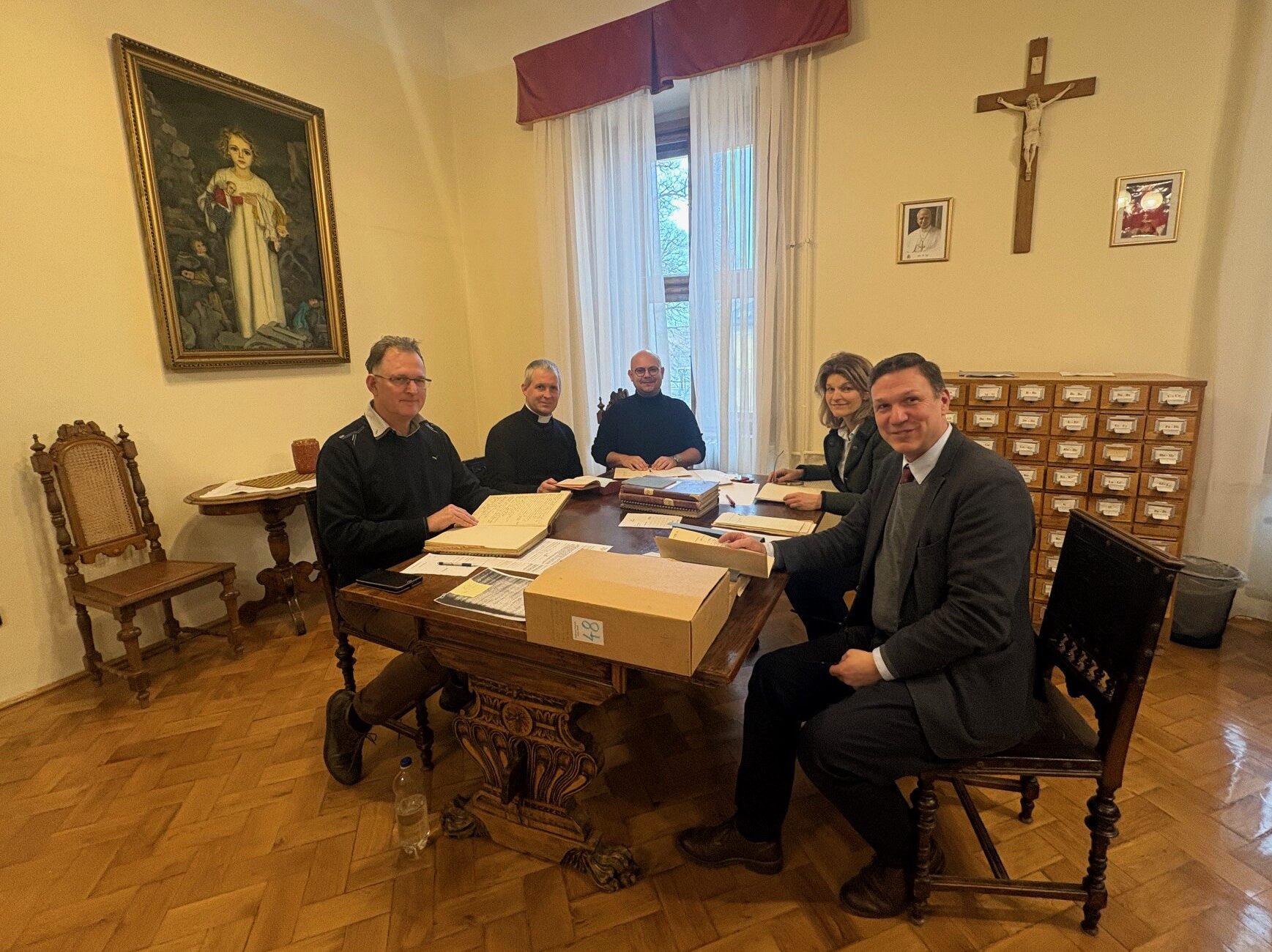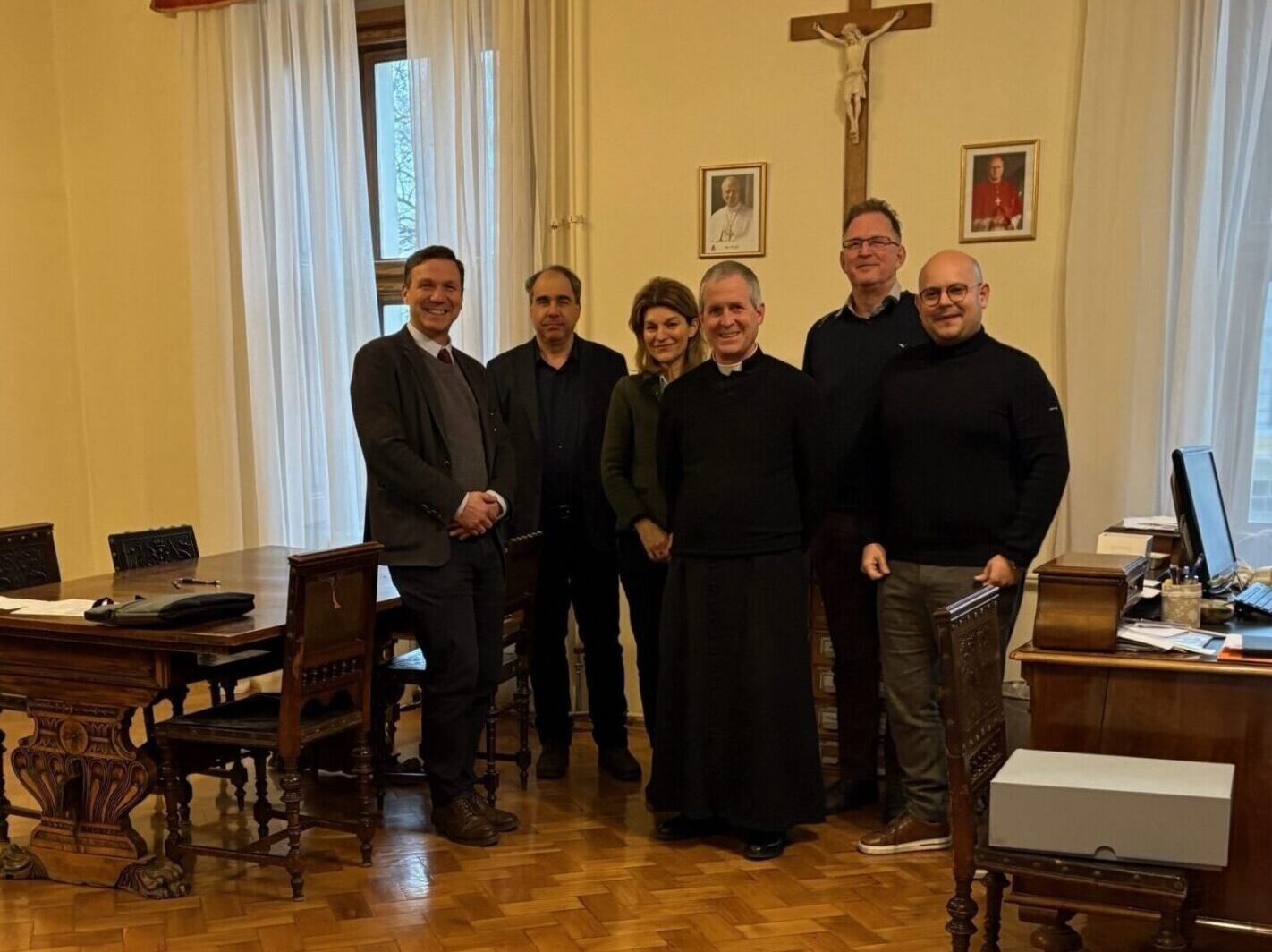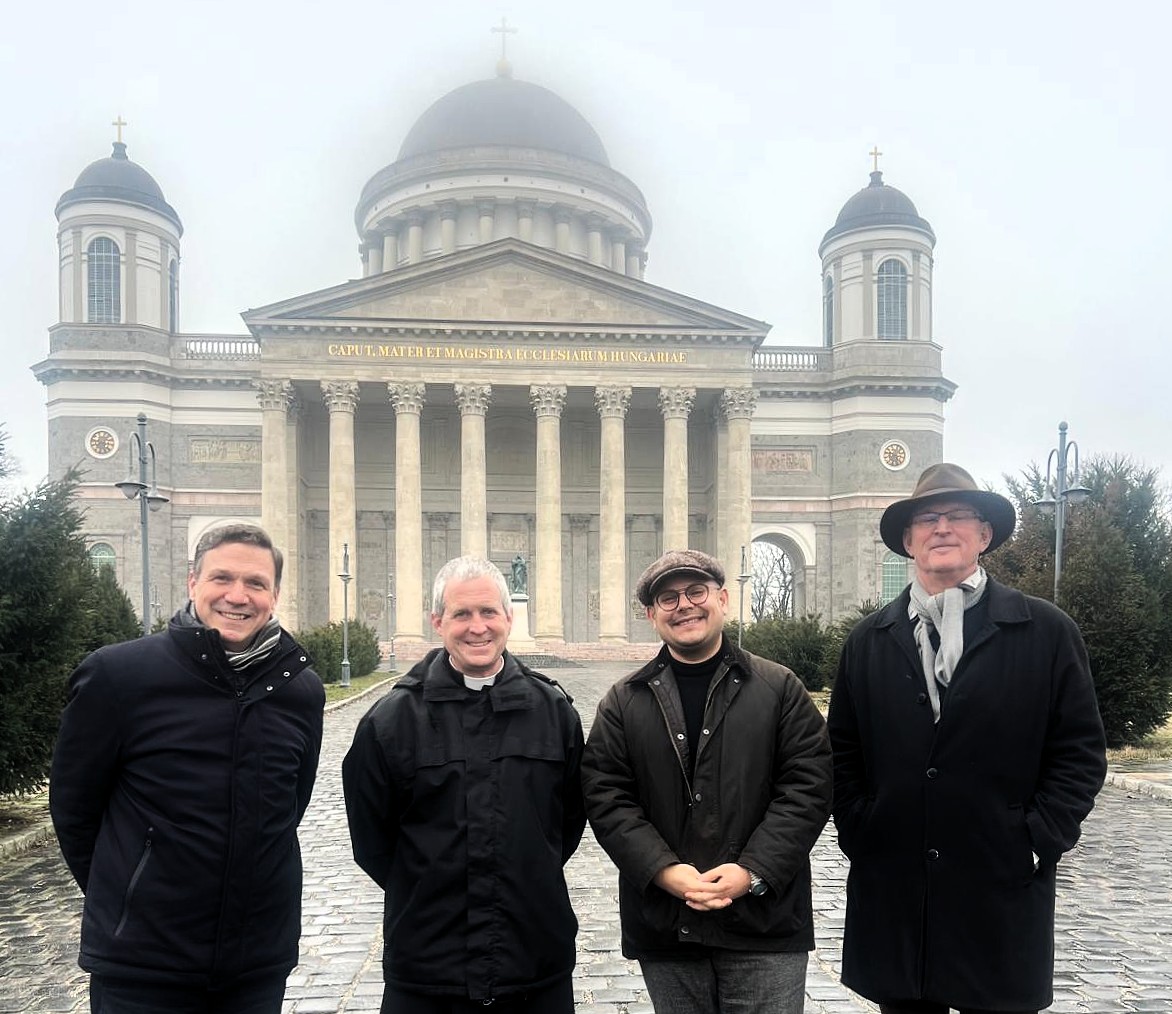
On 26 January, at the request of Father Jacques Olivier, postulator of the beatification cause of Otto von Habsburg’s mother, our Foundation’s Deputy Scientific Director, Gergely Fejérdy, joined the ongoing research at the Primate’s Archives of Esztergom. In addition to the French ecclesiastical representative, the research team included Norbert Nagy, vicepostulator; Réka Mária Erőss, President of the Association for the Beatification of Queen Zita, and Minister Counsellor of the Budapest Representation of the Sovereign Military Order of Malta; and Philippe Pellet, scholar at the University of Public Service. They were received by András Hegedűs, Director of the Primate’s Archives of Esztergom.
The focus of the information gathering was on documents connected to Empress and Queen Zita, dating from 1916 onwards. During the exploration, particular attention was paid to materials related to the coronation, which revealed significant and previously unknown information. Prior to the visit, the colleagues of the Archives had analysed the correspondence of Prince Primate János Csernoch (1912–1927), but found no relevant material directly linked to Queen Zita. The members of the delegation also reviewed the private letter exchanges of Prince Primate Jusztinián Serédi, who held the archepiscopal see of Esztergom from 1927, but this inquiry likewise yielded no records of decisive relevance concerning the mother of Otto von Habsburg. By contrast, in the case of József Mindszenty, Archbishop of Esztergom — who became head of the Catholic Church in Hungary in 1945 and was arrested by the communist state security authorities on 26 December 1948 — a report was identified within the trial records. This contains a testimony by his secretary, András Zakar, about a meeting in Canada between Otto von Habsburg and the Cardinal.
Although the brief investigation resulted in only partial success, it nevertheless highlighted that during the Horthy era, the leaders of the Hungarian Catholic Church maintained contact with the Habsburg family living in exile since 1919, with considerable caution and often through intermediaries. This may explain why no authoritative documents originating personally from Queen Zita are preserved in their private estates. Nevertheless, the archival holdings may provide our Foundation with a wealth of valuable historical data, making their further systematic exploration justified.
Following this, courtesy of Director András Hegedűs, the research team had the opportunity to view the throne preserved in Esztergom, which had been installed for Emperor and King Charles on the occasion of his coronation held at the Matthias Church in Budapest on 30 December 1916. During the visit, the discussion also touched upon the forthcoming anniversary and the manner in which our Foundation prepares to contribute to the commemorations.