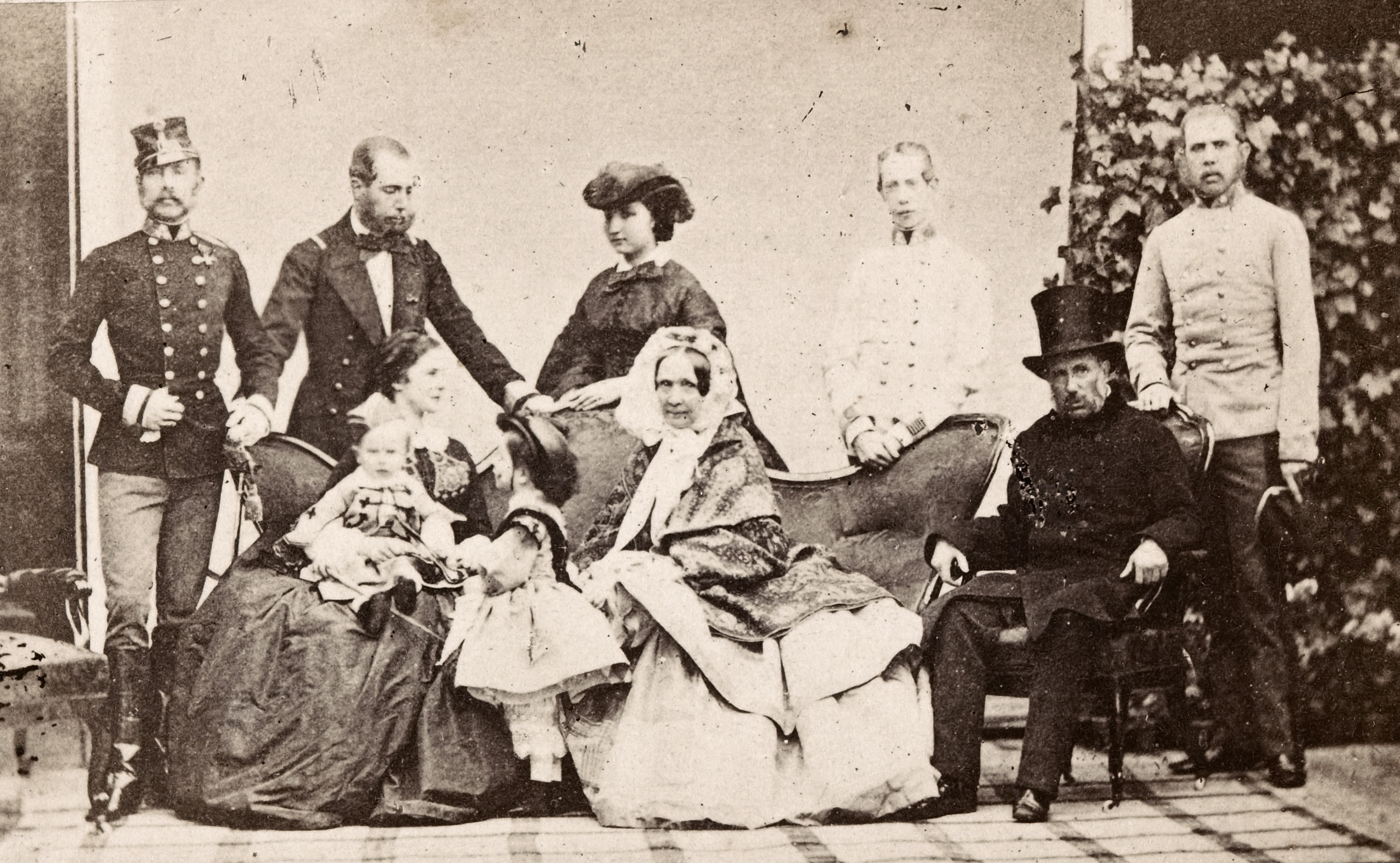
The imperial family on the terrace of Schönbrunn Palace. Standing on the left are Emperor Franz Joseph I, his younger brother Archduke Ferdinand Maximilian, and the latter’s wife, Charlotte; on the right are Archdukes Ludwig Viktor and Karl Ludwig. Photograph by Ludwig Angerer, c. 1860. Wien Museum, 104293.
.
We recently reported that, thanks to Karl von Habsburg, the Foundation had received a substantial body of documents consisting primarily of 19th-century correspondence. The material is currently being arranged and catalogued. Of particular value are nearly fifty letters exchanged from 1848 to 1866 between the elderly Empress Dowager Caroline Augusta and her step-grandson, Archduke Maximilian – the future Emperor of Mexico. Intimate in tone, they bear witness to a close family bond and offer a glimpse into the private world of the dynasty. They trace the increasingly dramatic course of Maximilian’s life, from his years as commander of the fleet in Trieste to the crisis that brought down the Mexican Empire, showing how his early confidence gradually yielded to despair.
The correspondence also has a connection to our Foundation’s namesake. Caroline Augusta was stepmother to Otto von Habsburg’s great-grandfather, Archduke Franz Karl, while Maximilian, as brother to Archduke Karl Ludwig, was Otto’s great-great-uncle.
Caroline Augusta at the Viennese court
Caroline Augusta was born in Mannheim in 1792 into the influential Bavarian House of Wittelsbach. With Napoleon’s support, her father, Maximilian I, became the first sovereign of the independent Kingdom of Bavaria in 1806. Guided by dynastic considerations, he arranged an early marriage for his daughter. Her union with Crown Prince William of Württemberg, however, remained childless and was annulled six years later with papal approval.
In 1816, she became the fourth wife of Emperor Francis I, assuming the titles of Empress of Austria and Queen of Hungary and Bohemia. Deeply religious, Caroline Augusta was among the few Habsburg consorts to enjoy genuine popularity at the Viennese court. Her approachable manner and her distance from intrigue contributed to this esteem. Above all, she was admired for her charitable activities, founding numerous hospitals and welfare institutions. She continued to command profound respect even in widowhood and was regarded as the embodiment of Christian values and dynastic unity.
The imperial family’s “common mother”
Caroline Augusta occupied a central place within the family. Skilfully navigating the dynasty’s intricate web of kinship, she cultivated exceptionally close ties with its various branches. A historical study written only twenty years after her death paid tribute to her in these words:
“The extended imperial family honoured Caroline as their common mother with filial love and, tellingly, never referred to her as anything other than the Empress Mother. Indeed, the tenderness with which she shared in the fortunes and experiences of its individual members and watched over them was the soothing breath of devoted maternal love.” [1]
The younger generation frequently sought her guidance. She relayed news among relatives, and her counsel sometimes helped to settle disputes. She was particularly attached to her niece, Duchess Adelgunde of Modena, and to her step-grandson, Archduke Maximilian.
Two kindred spirits: Caroline and Maximilian
An intellectual and emotional affinity developed between Archduke Maximilian and Caroline Augusta. They shared a deep religious faith, a moderately liberal outlook, and a keen interest in the arts and nature. Well versed in botany and a writer of poetry, he recounted his travels and observations of the natural world in letters to his grandmother that read almost like passages from a novel.
By contrast, his relationship with his elder brother, Franz Joseph, was considerably more strained. Their divergent personalities and political views gave rise to repeated conflict, while the emperor regarded Maximilian’s talent and charisma with apprehension.
From Trieste to the Novara’s circumnavigation
Maximilian’s love of the sea offered Franz Joseph an opportunity to direct his younger brother towards the navy. With the fleet command based in Trieste, he could be kept well away from the intrigues of the Hofburg without interpreting his new post as a sign of disfavour.
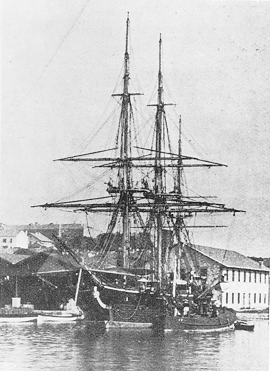
Maximilian entered naval service in October 1850 and advanced rapidly through the ranks. Four years later, at just twenty-two, he was appointed commander-in-chief of the Austrian fleet. The decision provoked fierce criticism in conservative court circles, yet his achievements soon proved his detractors wrong. He played a leading part in modernising the navy, and it was under his personal patronage that the imperial frigate Novara undertook its circumnavigation of the globe between 1857 and 1859. The expedition attracted substantial attention in the scientific community and brought the empire international recognition.
 |
Viceroy of Lombardy and the agreement at Miramare
In 1857, Franz Joseph named Maximilian viceroy of the Kingdom of Lombardy–Venetia. The more liberal-minded archduke sought to alleviate political tensions in the region through administrative, economic, and cultural reforms, although his scope for action remained limited.
That same year, he married Princess Charlotte, daughter of King Leopold I of Belgium. The loss of Lombardy following Austria’s defeat in the war against Sardinia and France in 1859 brought Maximilian’s tenure to an end, and the couple withdrew to Miramare Castle near Trieste.
Diplomatic negotiations over inviting Maximilian to assume the Mexican throne began in 1861, and a delegation from that country formally offered him the crown in the autumn of 1863. The proposal’s principal advocate was the French emperor Napoleon III. In Vienna, however, Maximilian’s acceptance would have serious dynastic implications, with Franz Joseph concerned above all about the order of succession in the House of Habsburg.
The family agreement settling the matter was signed at Miramare on 9 April 1864: in return for the Mexican imperial title, Maximilian relinquished his rights to the Austrian throne. After a final, strained conversation, both brothers were in tears as they took their leave. Their paths parted for ever; they would never see one another again.
A Habsburg sovereign on the Mexican throne
Maximilian took the imperial oath on 10 April 1864 and reached Mexico aboard the Novara in late May. From the outset, his authority rested upon precarious foundations. French troops provided the bulk of the empire’s military strength, while he sought to broaden his political base by enlisting moderate forces. This alienated some of his conservative adherents as well as the Catholic hierarchy, yet he had no prospect of securing the support of the republicans led by Benito Juárez.
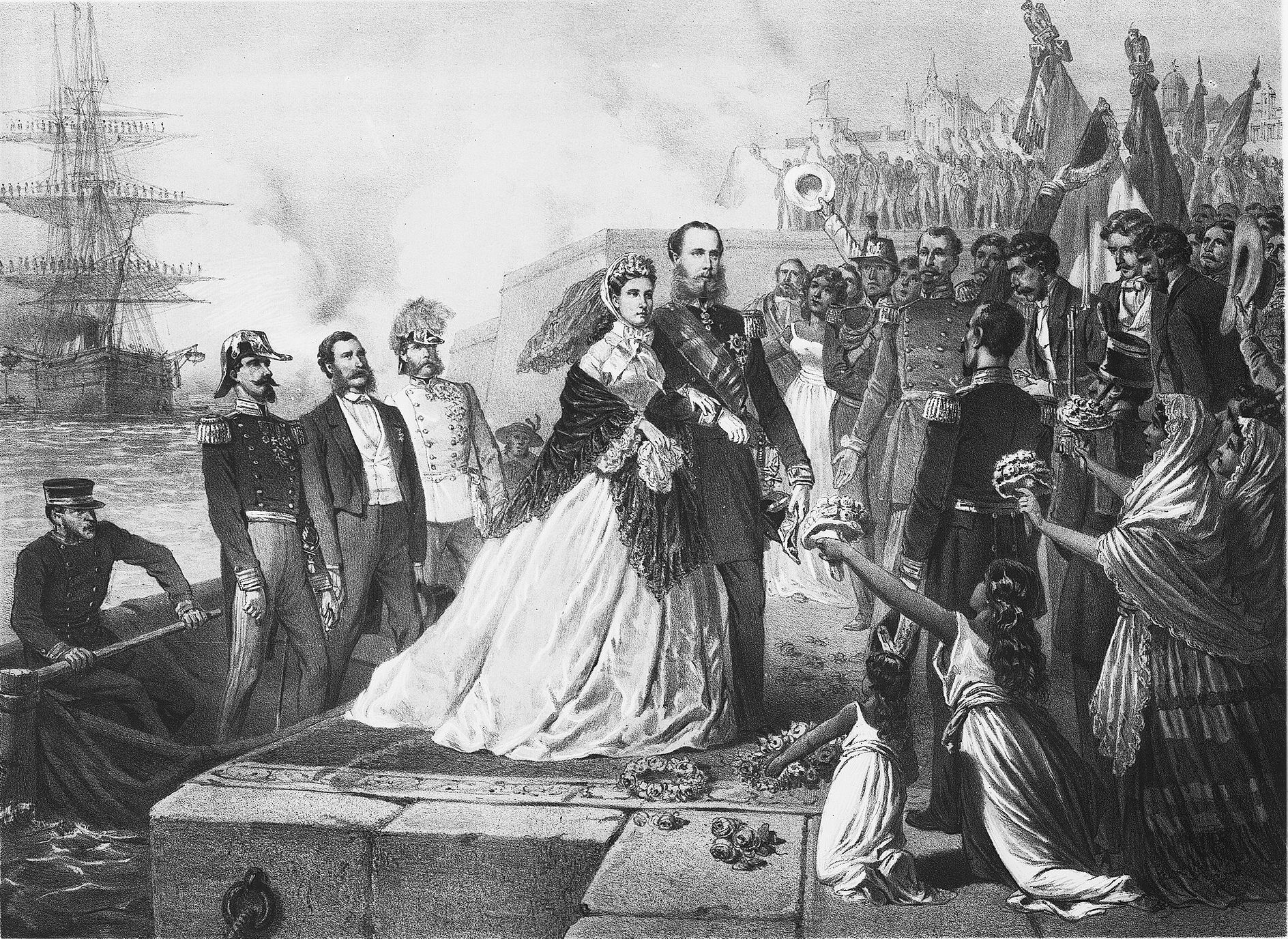
Emperor Maximilian of Mexico and Empress Charlotte arriving at the port of Veracruz, 1864.
International realignment and the propaganda war in America
After the American Civil War, the United States, acting in the spirit of the Monroe Doctrine, recognised Juárez’s presidency in Mexico rather than Maximilian’s imperial rule. By 1866, the political situation had changed fundamentally. Sustained pressure from Washington, together with the financial burden and domestic repercussions of the venture, ultimately prompted Napoleon III to abandon the intervention. Austria’s defeat at Königgrätz further narrowed the Mexican emperor’s options and finally persuaded the French to redeploy their troops to Europe.
Maximilian nevertheless sought external support. He established a clandestine agency in New York and pursued a diplomatic and press campaign to win over American public opinion, but these efforts could not alter the course of events.
Among those involved in this lobbying was the Hungarian military officer Béla Estván, who had led an eventful life. In return for exceptionally generous remuneration, he diligently despatched reports to Mexico, but embezzled most of the funds entrusted to him. His fraudulent conduct continued in Europe: after returning home in 1872, he presented Franz Joseph with a fictitious claim for 80,000 dollars, purportedly owed for his earlier services. A court eventually sentenced him to six years’ imprisonment.
In the shade of the magnolias: from confidence to despair
The letters to Caroline chart Maximilian’s passage from optimism to despondency. On 20 August 1864, his tone was still buoyant:
“We have both adjusted quite well to our new circumstances; we trust in God and are very content. From all sides, people support us with touching affection.”[2]
Barely a year later, the tenor of his messages had darkened perceptibly. In September 1865, he deplored the country’s “lamentable condition” and the open hostility of its population. By December, he was describing his own situation as “hopeless”. The following February, seeking to reassure the anxious Empress Dowager, he wrote rapturously about the beauty of the Mexican landscape and its “paradisiacal magnolia trees”. Yet beneath these words lies an unmistakable foreboding of political catastrophe.
Charlotte’s mission and the abandoned emperor
Napoleon III’s decision to withdraw the French troops deprived Maximilian of his main source of military support. Meanwhile, the Mexican state’s finances continued to deteriorate, as France used much of the country’s customs revenue to recoup its earlier war expenditure.
Empress Charlotte travelled to Europe in the summer of 1866 to obtain assistance for her husband, but her mission failed at both the French court and the Vatican. She then suffered a severe psychological crisis. Contemporary accounts record that she was tormented by paranoid delusions and never recovered from her illness, despite all the efforts of the family’s physicians.
It is apparent from Maximilian’s letters that he too was close to breaking point. Sustained by his sense of dynastic duty and pride, however, he held his ground. By August 1866, prepared for every eventuality, he was writing to Caroline in a valedictory tone:
“…I fear I may never again have the opportunity to see you, dear Grandmother.”[3]
In a message to his chamberlain, he affirmed his resolve to uphold the honour of the House of Habsburg to the end:
“The French troops are leaving Mexico. Whatever may happen, I shall not desert my post, and I shall never forget that I belong to a dynasty which has survived crises far graver than the present one. I shall not tarnish the centuries-old glory of my ancestors.” [4]
The final act in Querétaro
True to his declaration, Maximilian stayed in Mexico and confronted the republican forces at Querétaro. After the city fell, he surrendered unconditionally and was sentenced to death by a military court. European rulers and several eminent figures of the age, including Victor Hugo and Giuseppe Garibaldi, appealed for clemency, yet President Juárez refused to commute the sentence. Consequently, on the morning of 19 June 1867, the emperor was executed alongside two loyal generals on the Cerro de las Campanas. According to the sources, he faced his fate with dignity; his final words were spoken in Spanish:
“I forgive everyone, and I ask everyone to forgive me! May the blood I shed serve the good of this country! Long live Mexico! Long live independence!”[5]
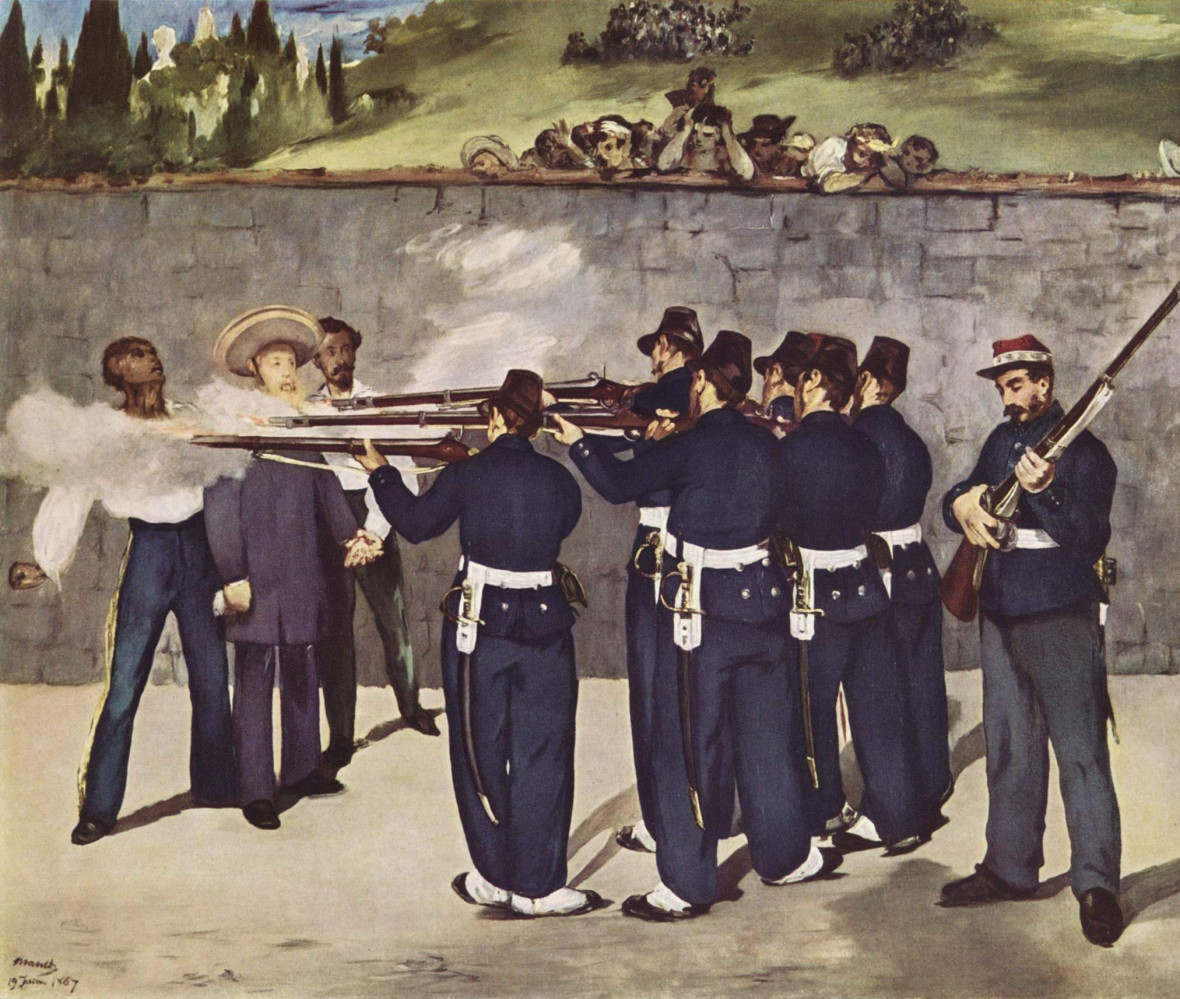
Édouard Manet: The Execution of Emperor Maximilian
The Novara carried his body back to Europe. The frigate had accompanied Maximilian through the principal stages of his life: he began his career as a naval officer aboard it, and it later served as his flagship when he commanded the fleet. He even had the bedroom of his seaside castle modelled on the captain’s cabin of the ship that meant so much to him. In 1864, the imperial couple had sailed for Mexico on the same vessel; three years afterwards, it brought his mortal remains home.
More than a thousand Hungarian soldiers served in the imperial volunteer corps established in 1864 for the Mexican campaign. Unlike Maximilian, those taken prisoner at Querétaro were allowed to leave freely. This owed much to the fact that General Porfirio Díaz had previously escaped from captivity with the help of János Csizmadia, a first lieutenant in the hussars.
Epilogue: the memory of the “heroic victim”
The tragic Mexican venture continued to occupy the Hungarian public imagination for decades. Ede Pawlowski, a veteran who had witnessed the events, summed up his impressions in an article published in the weekly Vasárnapi Újság in 1882:
“Maximilian appears above all as a heroic victim, who sacrificed his own life for Mexico, its peace, and its prosperity. His downfall was largely due to the ignorance of the local population. The empire’s sound institutions failed and remained ineffectual because the people were incapable of understanding them…”[6]
In his view, the country across the Atlantic might have made remarkable progress under Maximilian’s enlightened rule; he attributed the failure to realise that promise primarily to its inhabitants.
The correspondence between Caroline Augusta and Maximilian offers valuable insights into the character and career of this forward-looking archduke, who deserved a better fate. Its significance, however, extends beyond the political history of the Mexican Empire. At the heart of these letters is a close family bond: here, Maximilian is not only an archduke, fleet commander, or sovereign, but also a grandson who could confide his doubts and share his successes with someone he trusted. Caroline’s replies, in turn, convey the Empress Dowager’s affection and heartfelt concern for him. The personal perspective preserved in the Foundation’s collection lends Maximilian’s tragedy an enduring immediacy, making this exchange one of the most direct and profoundly human sources on his life.
Gábor Ladányi
[1] Wolfsgruber, Cölestin: Carolina Auguste, die „Kaiserin-Mutter”. Vienna, Heinrich Kirsch, 1893, 194.
[2] Otto von Habsburg Foundation, Otto von Habsburg Collection, HOAL-I-1-i, Emperor Maximilian I of Mexico, Querétaro, 20 August 1864 (archival arrangement in progress).
[3] Otto von Habsburg Foundation, Otto von Habsburg Collection, HOAL-I-1-i, Emperor Maximilian I of Mexico, Chapultepec, 15 August 1866 (archival arrangement in progress).
[4] Hellwald, Friedrich von: Maximilian I. Kaiser von Mexico. Vienna, Wilhelm Braumüller, 1869, 496.
[5] Corti, Egon Caesar Conte: Die Tragödie eines Kaisers. Maximilian von Mexiko. 3rd edn. Vienna, Baron Verlag, 1951, 397.
[6] Venkovits, Balázs: „A császárságnak buknia kellett.” Habsburg Miksa és a magyarországi Mexikó-kép alakulása. Aetas, 2014, 2, 43.