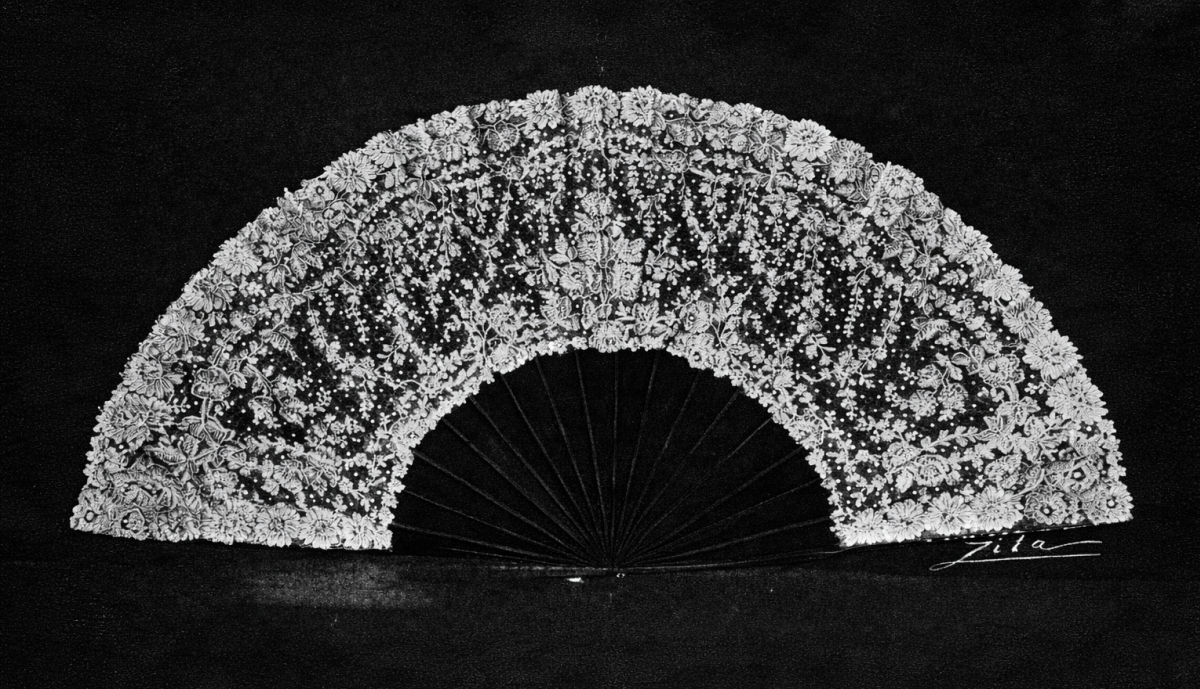
Queen Zita’s lace fan (with the handwritten signature ‘Zita’ on the right).
Az Érdekes Ujság, 21 February 1918, p. 28.
One hundred and eight years ago, in February–March 1918, during the final months of the First World War, an unusual object appeared in an elegant villa in Budapest. A lace fan once used by Queen Zita – wife of King Charles IV and the last Queen of Hungary – was put on display in the Jungfer–Ullmann villa at 18/a Városligeti fasor (today No. 20). The fan, adorned with diamonds, quickly became the highlight of a remarkable charity exhibition.
Why was a personal belonging of the Queen displayed in a private residence in Budapest? The answer lies in the representational and charitable practices that became increasingly important during the years of war.
The Jungfer–Ullmann Villa as an Exhibition Venue
The two-storey villa at Városligeti fasor 18/a was one of the most distinguished residences in turn-of-the-century Budapest. It was built in 1891 for the master locksmith and decorative iron manufacturer Gyula Jungfer, based on plans by the architect Artúr Meinig. Jungfer lived there from 1892 until his death in 1908.
After his death, the property was purchased by the architect Gyula Ullmann (1872–1926), who renovated the building in 1911 according to his own designs. Following this transformation, the villa functioned not only as a private home but also as a venue for cultural and social events. Its richly decorated interiors proved ideal for hosting exhibitions, receptions and charity gatherings.
It was therefore no coincidence that the organizers of the fan, lace, embroidery and decorative pillow exhibition chose this residence as their venue. The villa embodied both bourgeois prestige and a sense of social responsibility – an ideal setting for an exhibition that carried special meaning during the wartime years.
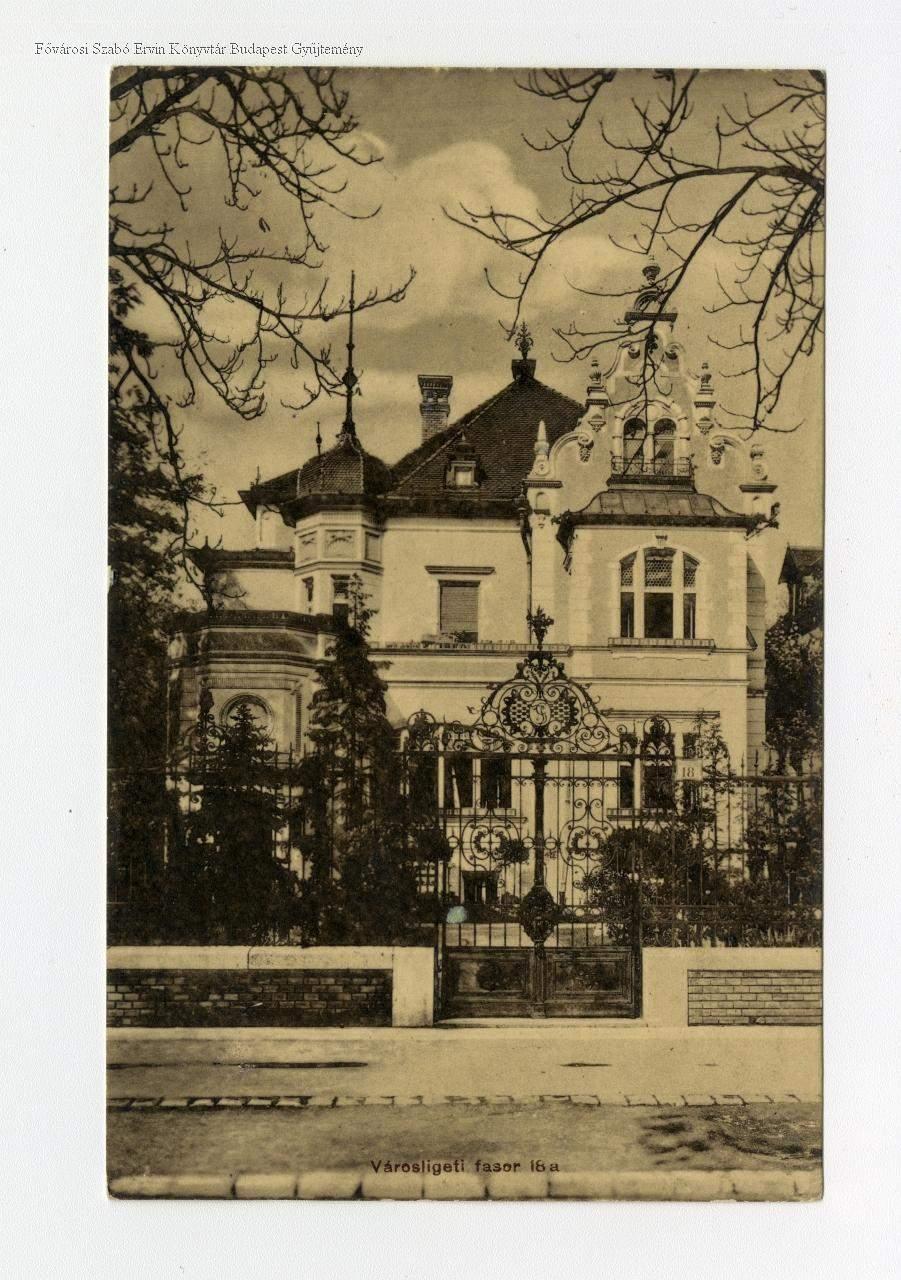
The Jungfer–Ullmann villa between 1910 and 1916
Source: Metropolitan Ervin Szabó Library – Budapest Picture Archive
A Request Through the Grand Master of the Court
On 6 February 1918, Sándorné Lónyay[1], the executive director of the “Auguste Quick Aid Fund” (Gyorssegély Auguszta Alap)[2], wrote to Count Sándor Esterházy[3], Queen Zita’s Obersthofmeister. She asked him to convey her request to the Queen: that she might contribute an item to the exhibition of cushions, lace, fans and embroidery organized under the patronage of Archduchess Auguste[4].
Displaying royal relics – such as jewellery, clothing or family photographs – was a common and carefully used method at the time to encourage public engagement and donations. Queen Zita’s fan was therefore more than a symbolic gesture. It served a clear representational and charitable purpose. The exhibition itself was not intended merely as a display of decorative arts but also as a fundraising initiative. All proceeds were donated to the “House of the Nation” (Nemzet Háza)[5], an institution supporting soldiers wounded or disabled in the war, as well as to the widows and orphans of the Royal Hungarian 4th Honvéd Hussar Regiment of Subotica. In this way, the exhibition combined cultural presentation with wartime relief efforts, linking aesthetic appreciation with social responsibility.
A Collective Act of Charity
Organized by the Auguste Quick Aid Fund, the exhibition formed part of a broader wave of charitable and cultural initiatives led by aristocratic and upper-middle-class women. In the final year of the war – amid the gradual disintegration of the Habsburg Monarchy – noblewomen and prominent society figures played an important role in sustaining fundraising activities and maintaining cultural life, while also assuming new forms of public engagement.
The objects on display – lace fans from different periods, richly embroidered decorative cushions made of luxurious fabrics, items from bridal trousseaus, historic family embroideries, porcelain figurines and miniature artworks – were all representative pieces of the female domestic sphere. Once placed on public display, these personal and aesthetically valuable items not only delighted visitors but also encouraged charitable giving.
Most of the exhibition pieces came from private collections and were assembled by what contemporary sources described as “the capital’s distinguished society.” At the head of the exhibitors stood Archduchess Auguste herself, who lent the exhibition legitimacy by displaying her own wedding fan. Members of prominent aristocratic families – including the Apponyi, Batthyány, Kállay and Lónyay families – contributed family heirlooms, alongside patrons from banking and industrial circles and leaders of cultural and charitable associations.
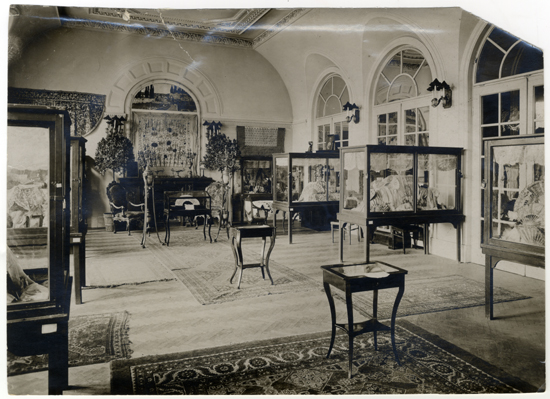
Charity lace and fan exhibition at Gyula Ullmann’s villa, 18 Városligeti fasor, Budapest
Photograph by János Müllner, 1918. Source: Hungarian National Museum
“A Brilliant Lace Fan”
The most prized object of the exhibition was Queen Zita’s lace fan[6]. It was transported from Vienna to Budapest by a non-commissioned officer of the royal bodyguard and arrived just in time for the opening day.
The fan was exceptional in several respects. Its delicate lace and precious stones emphasized both its luxurious character and its ceremonial significance. On one side appeared the Queen’s own handwritten signature – “Zita” – which lent the object a deeply personal touch and transformed it into an authentic royal relic. On the other side, a crown motif symbolized royal dignity and state representation.
By lending the fan to the exhibition, the Queen placed a personal object at the service of a wartime charitable cause. Beyond its aesthetic value, the fan thus became a symbol of royal support and national solidarity.
It was precisely this combination – luxury craftsmanship, personal signature, royal symbolism and charitable purpose – that made the fan the exhibition’s most admired and valuable piece.
Visitors and Distinguished Guests
The exhibition was open to the public from 10 February to 6 March 1918, welcoming visitors daily between 10 a.m. and 6 p.m. On Wednesdays and Saturdays, afternoon tea gatherings were hosted by prominent ladies of Budapest society, transforming the charity exhibition into a lively social occasion.
Admission tickets cost between two and five crowns. At a time when a day labourer typically earned three to six crowns, this represented a considerable sum. Attendance itself therefore amounted to a form of donation.
Among the distinguished visitors were Archduchess Sophie[7], the daughter of Archduchess Auguste, and Prince Konrad of Bavaria[8], whose presence further enhanced the event’s prestige and dynastic character.
Queen Zita herself, however, did not visit the exhibition. Her absence – especially given that she had contributed its most valuable piece – suggests that her support was intended primarily as a symbolic and representative gesture. Instead of appearing in person, the Queen allowed her lace fan to represent royal approval and participation, a form of restrained yet meaningful support in keeping with court practices during the wartime years.
The Afterlife of the Exhibition
Held within the walls of the Jungfer–Ullmann villa, the 1918 exhibition was at once an art display, a social gathering and a wartime charity initiative. Although it remained open for only three weeks, it offered a revealing snapshot of the final year of the First World War: within a Budapest villa, dynastic representation, female patronage and national solidarity briefly came together.
After the exhibition closed, the objects were returned to their owners. Contemporary newspapers did not record the exact number of visitors or the total revenue raised. Reports of the opening nevertheless indicate that the exhibition attracted large audiences, who described it as an “exceptionally fascinating, beautiful and valuable” display.
Queen Zita’s lace fan was returned to Vienna with the assistance of the Office of the Grand Master of the Court (Obersthofmeisteramt). The Queen reportedly expressed great satisfaction with the favourable reception of the exhibition and was pleased that lending her fan had contributed to its success.
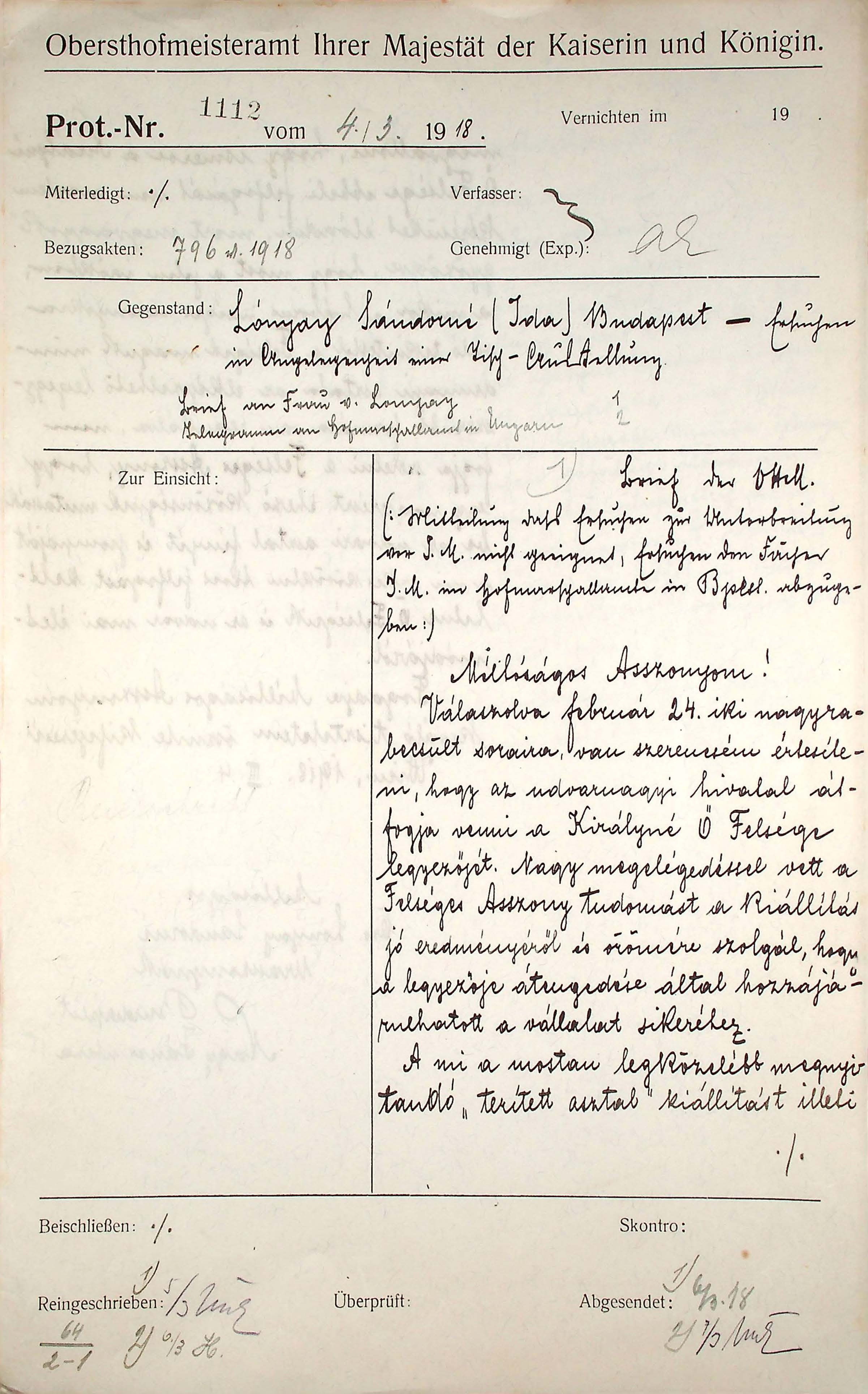
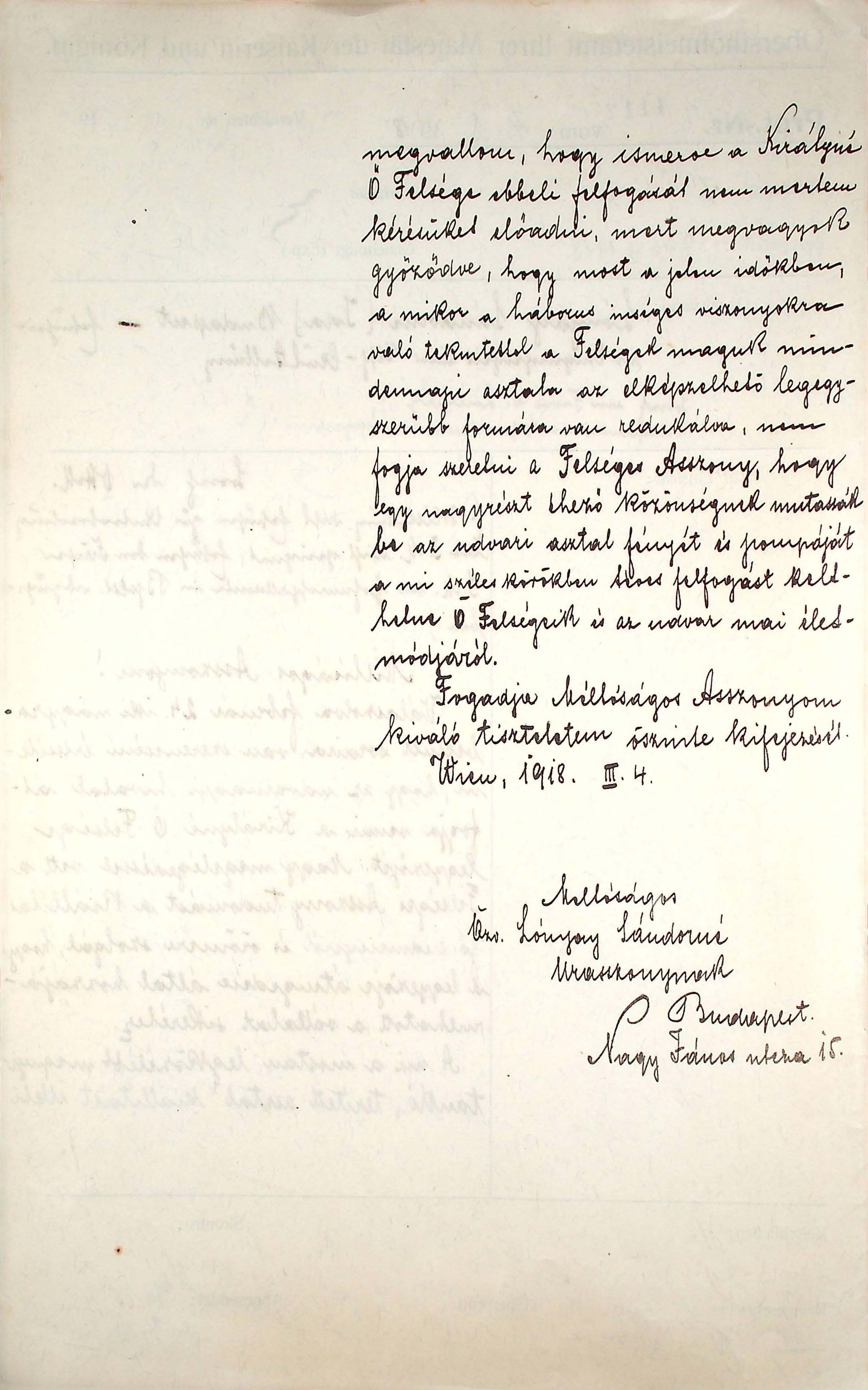
Reference number: HOAL I-1-2-64-2-1/1112/1918
The later fate of the fan remains unknown. Yet its brief appearance in Budapest offers a vivid example of how a personal object could, during the years of war, become a symbolic expression of dynastic support and collective solidarity.
Piroska Kocsis
[1] Ida Becsky (1874–1942), widow of Sándor Lónyay of Nagy-Lónya and Vásáros-Namény, was a journalist whose salon served as a meeting place for politicians, writers and artists of the early twentieth century. As executive director of the Auguse Quick Aid Fund, she played a key role in wartime charity efforts. As one contemporary account described it, she “wrote, campaigned, collected donations, went from house to house asking and pleading, organized concerts and theatrical performances, and created a fund worth many millions that helped dry countless tears.”
[2] The Auguste Quick Aid Fund was a nationwide charitable organization founded in the first days of the First World War as an aristocratic civic initiative.
[3] Count Sándor Esterházy of Galántha and Fraknó (1868–1925), landowner of Marcaltő and son of Count Pál Esterházy. He served as Privy Counsellor, Grand Master of the Court to Queen Zita, Imperial and Royal Chamberlain, Knight of the Order of the Golden Fleece, and hereditary member of the Hungarian House of Magnates.
[4] Archduchess Auguste Maria Luise of Bavaria (1875–1964), a member of the House of Wittelsbach and granddaughter of Emperor and King Franz Joseph I, was the wife of Archduke Joseph August of Austria. During the First World War she became widely known as the “guardian angel of Hungarian wartime relief,” actively participating in nursing the wounded and playing a leading role in charitable initiatives.
[5] The House of the Nation was a charitable and relief institution established in Budapest during the First World War to support wounded and disabled soldiers.
[6] At the turn of the nineteenth and twentieth centuries, the fan was not merely a practical accessory but also a luxury fashion item, a work of decorative art and a marker of social status. A lace fan adorned with diamonds functioned both as a piece of jewellery and as a symbol of prestige, making it an especially suitable object for exhibition.
[7] Archduchess Sophie (1899–1978), daughter of Archduchess Auguste.
[8] Prince Konrad of Bavaria (1886–1969), brother of Archduchess Auguste.