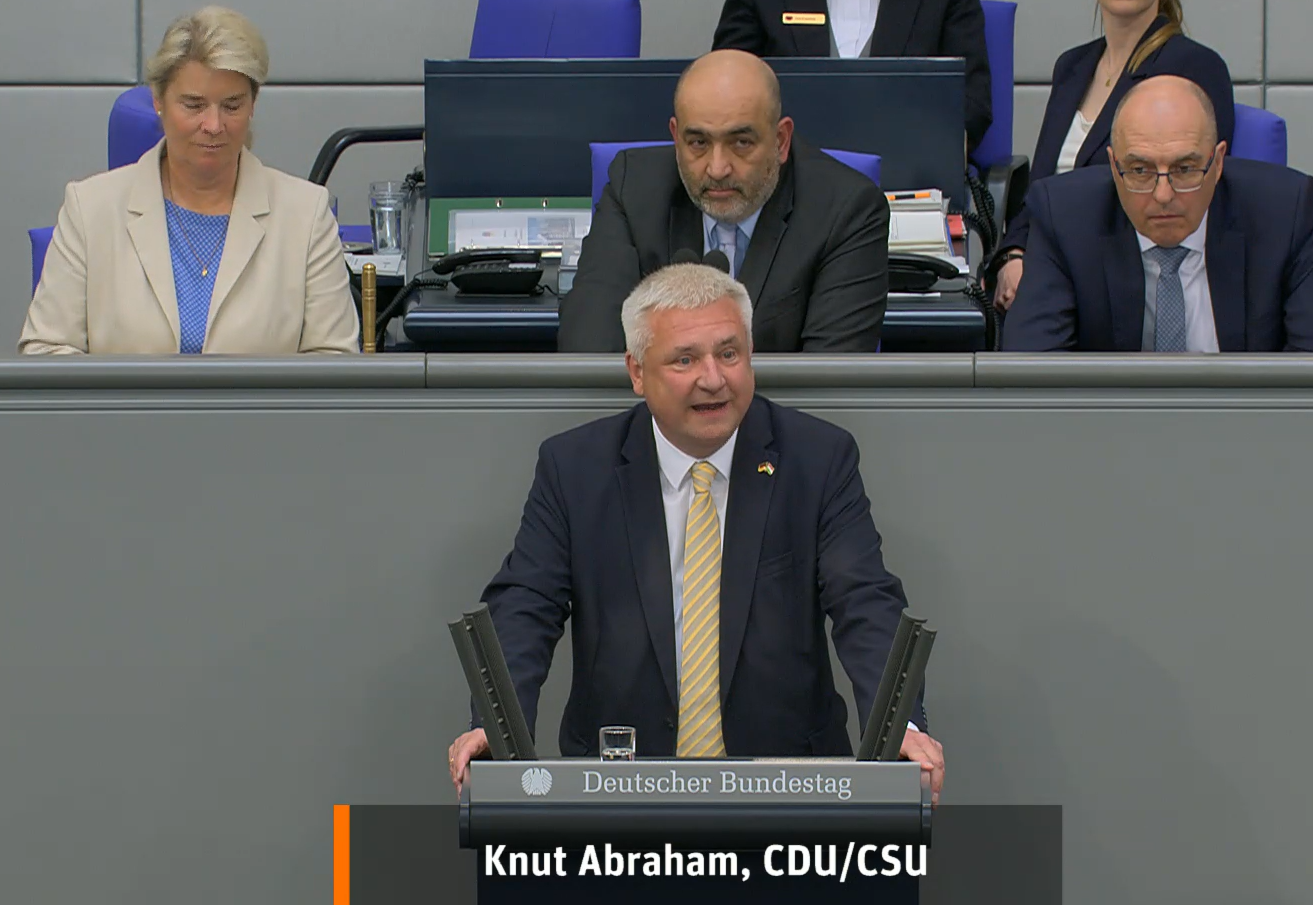
Having begun his career within Otto von Habsburg’s staff, and, after several decades in diplomatic service, has been a member of the Bundestag for the CDU/CSU parliamentary group since 2021, Knut Abraham spoke on 16 April in the lower house of the federal parliament during the Aktuelle Stunde, a format dedicated to the discussion of current political issues. On this occasion, the focus was on the recent Hungarian parliamentary elections held the previous Sunday (Ungarn nach der Wahl – Neue Chance für Europa; Hungary after the election – a new opportunity for Europe), with the representatives of the parliamentary groups outlining their positions in short interventions.
Speaking on behalf of the CDU/CSU, the politician, who is highly familiar with Central European affairs, emphasised at the outset that the bronze plaque commemorating the Pan-European Picnic on the north-eastern wall of the Reichstag is a symbol of historical and collective memory in which the story of Europe’s reunification is encapsulated. At the same time, the plaque also serves as a reminder that German–Hungarian relations – their broader bilateral framework – are dialectical in nature: shaped by the dynamics of rapprochement and divergence, and therefore in constant need of renewal, attention, and fresh impetus.
The Member of Parliament for Lower Lusatia expressed his hope that, following the recent vote, a new chapter may open in links between the two countries, as well as in Hungary’s relationship with the European Union. He also noted that channels of dialogue have remained open even in less favourable periods. While stressing the importance of cooperation capable of transcending day-to-day political differences, the speaker referred to Otto von Habsburg, one of the principal patrons of the Pan-European Picnic, often regarded as a “defining moment” in modern German–Hungarian ties, whose intellectual and political legacy is today preserved by our Foundation.
At the conclusion of his remarks, Knut Abraham stated that we are now facing an exceptional opportunity for a new beginning, one that entails considerable responsibility. Through the scholarly study of Otto von Habsburg’s oeuvre and the stewardship of his legacy, our Foundation – mindful of this responsibility – continues to contribute to strengthening bilateral ties and deepening cooperation both in Central Europe and across the wider European context.