Exactly seventy years ago, on 31 October 1956, he recorded the following in his diary: “Pöcking, grey, cold. Morning: meeting with Lovrek, Gaupp, and Waldburg. Afternoon: Lovrek and Meran leave for Vienna. Wrote to Cardinal Mindszenty; worked on numerous letters, memoranda, etc. Mindszenty has returned to Budapest. The Russians have withdrawn… Israel, France, and Britain go to war against Egypt.”
Those who gathered on the morning of October’s last day belonged to the former Crown Prince’s extensive network of contacts.[1] Georg von Gaupp-Berghausen (1918–1985), an Austrian military officer and politician, was a longstanding friend who had arrived in Pöcking on 29 October. The two regularly discussed developments in Hungary. After the war, Gaupp had worked in the Salzburg provincial government; from 1952, he served as director of the Neues Abendland publishing house. That same year saw the establishment of the European Documentation and Information Centre (CEDI), with substantial assistance from Otto von Habsburg; Gaupp also took part in its work. The organisation sought to promote cooperation among Western European Christian and conservative circles, gather information, oppose communism, defend their shared values, and advance European integration. Another CEDI member at the meeting was Count Alois von Waldburg-Zeil (1933–2014), who later represented the Christian Democratic Union (CDU) in the Bundestag, Germany’s federal parliament. Lastly, August Lovrek (1911–2003), a legitimist businessman from Salzburg, had been imprisoned in the Dachau and Flossenbürg concentration camps after Nazi Germany’s annexation of Austria because of his ties to the Habsburg heir. During the 1950s, he acted as Otto’s chief representative in Austria.
Count Ferenc Merán of Csákberény, mentioned in the journal entry, had distant Habsburg ancestry. Otto entrusted him with the letter he had just completed for Cardinal József Mindszenty, Prince Primate of Hungary. Later renowned as a professional safari guide in East Africa, the Count was then head gamekeeper on the Belgian royal family’s hunting estate in the Austrian Alps. His reputation for adventurousness suggested that he was well suited to such a hazardous assignment. That same day, Otto wrote to Lilian, Princess of Réthy (née Baels), wife of Belgium’s former King Leopold III, seeking her retrospective consent to their employee’s secret mission to Budapest. Merán duly delivered the missive to Mindszenty, as he later related in his memoirs.[2]
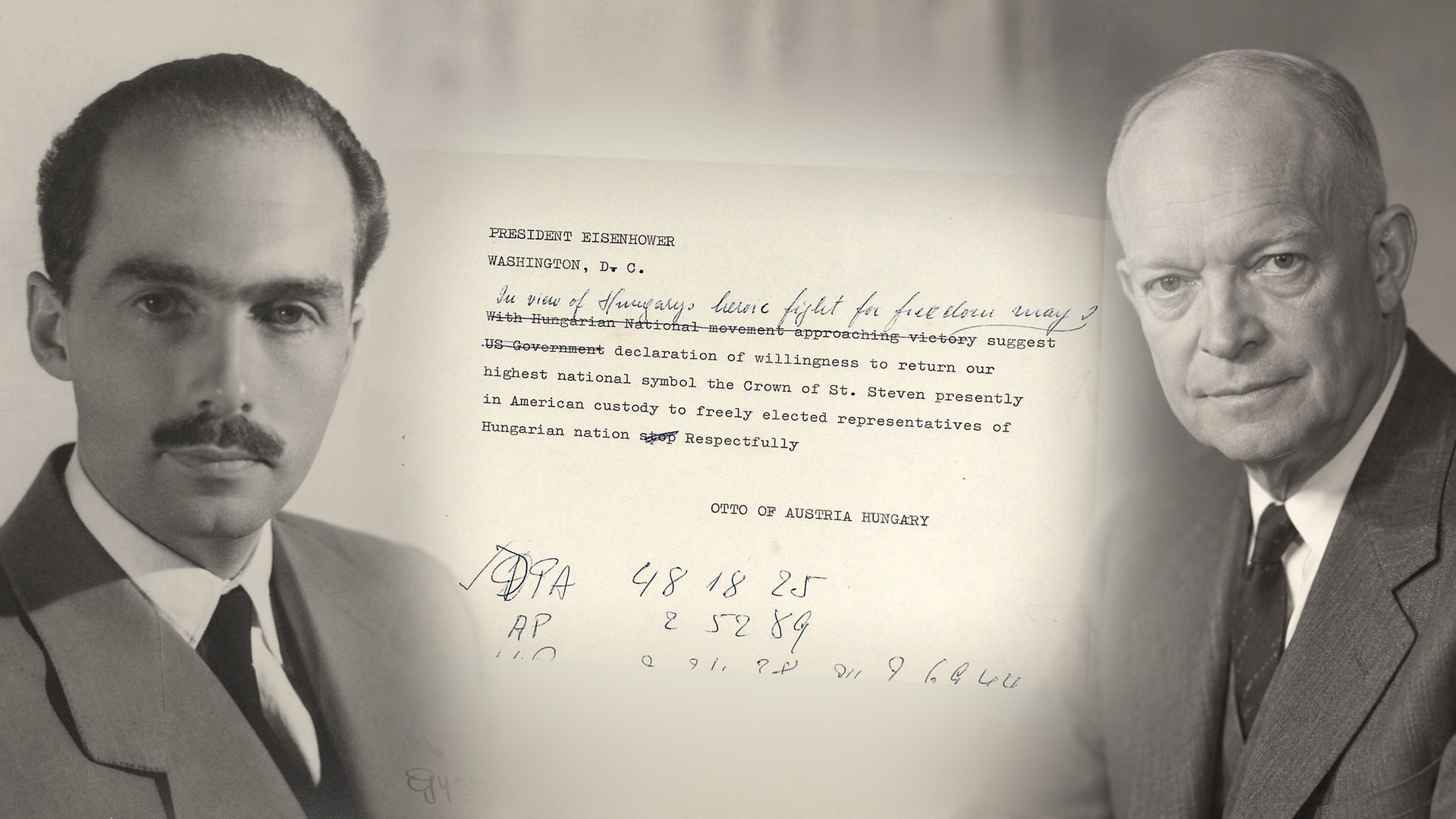
Although Otto had kept meticulous appointment diaries since the 1930s, the entry for 31 October did not mention his telegram to Dwight D. Eisenhower, then campaigning for a second term as US president. Several preliminary versions in German preceded the brief text sent to Washington. The English draft, incorporating handwritten corrections, reads: “In view of Hungary’s heroic fight for freedom may I suggest declaration of willingness to return our highest national symbol the Crown of St. Steven presently in American custody to freely elected representatives of Hungarian nation.”[3]
He circulated its contents to German- and English-language news agencies as well. His initiative elicited no response from Washington, but provoked considerable indignation in certain German circles. Although resident in Bavaria since 1954, he did not yet hold citizenship of the Federal Republic. On 15 November, Walter Stain, the Bavarian Minister of Labour, sharply criticised him and asked his counterpart at the Interior Ministry to examine his political activities. Left-wing Hungarian newspapers likewise published hostile articles that deliberately distorted his suggestion. Even a journalist at the respected Frankfurter Allgemeine Zeitung attacked the telegram. Count Heinrich Degenfeld-Schönburg, Otto’s private secretary, protested in a letter to the editors on 18 November.
At the time of the October meeting, the Archduke still believed that free elections could be held in Hungary. He hoped an American declaration would hearten its people, bolster the country’s sovereignty, and foster national unity. He envisaged the actual handover only after the vote, by which time he trusted that independence would have been secured. In later interviews, he stressed that the Crown stood above party politics:[4] for him, it embodied national unity and sovereignty. His proposal was therefore intended neither to prepare for his own accession to the throne nor to bring about a restoration of the monarchy.
In a 1978 analysis, he wrote: “For a thousand years, the Holy Crown has meant to every Hungarian what the Declaration of Independence and its original manuscript, as a relic, have meant to Americans for two hundred years.”[5] He believed that its symbolic power could even contribute to the disintegration of the communist regime: “Hungarians in exile, too, must do everything they can, drawing on their frequent contacts with those at home, to uphold what the Crown’s presence in Hungary signifies above all: the survival of aspirations to independence and the nurturing of the longing for freedom. They must use every means to strengthen the spiritual influence of the Holy Crown and the noble inspiration it imparts. We know, for instance, how profoundly its return stirred the Hungarian press, and how difficult the country’s distinguished journalists found it to accept that the all-powerful state had once again manipulated their articles. We know that even communist officials were moved by the Crown’s homecoming and for a while cast off their ideological straitjackets. Even the chief Stalinist functionary at the ceremony may have felt his throat tighten with an emotion he himself could not have named. They seek to strip the Crown of the epithet ‘Holy’, but their attempt may fail. It was unworthy, and misguided in terms of realpolitik, to return the Holy Crown to a dictatorship under foreign occupation and dependent upon it, yet the Crown may overcome even this. Perhaps the recklessness with which this matter was handled will prove to be that spirit of negation of which Goethe wrote: ‘Part of that Power, not understood, Which always wills the Bad, and always works the Good’ – ‘Ein Teil von jener Kraft, Die stets das Böse will und stets das Gute schafft’.”[6]
The subsequent political transformation also made it possible to fulfil the hopes our namesake had expressed three decades earlier. The former heir to the throne both witnessed and helped to bring about the fall of the Iron Curtain, and lived to see the Soviet army withdraw from Hungary. In 1988, he was once more able to pay homage to the Holy Crown, on display at the Hungarian National Museum, more than seventy years after his father, Charles IV, had been crowned with it in December 1916. The occasion probably reminded him of the turmoil of the 20th century, including the revolution of 1956. In a letter to Milton Eisenhower, the American president’s brother, dated 7 November that year, he described those days in these words: “I truly think, that these were days without parallel in human history in greatness, sacrifice, courage, and love of liberty.”[7]
Gergely Fejérdy
[1] For a fuller account, see Gergely Fejérdy: Habsburg Ottó és az 1956-os forradalom. Századok, 2021, 5, 1003–1024.
[2] Ibid., 1011.
[3] Otto von Habsburg Foundation, HOAL I-3-f, telegram from Otto von Habsburg to Dwight D. Eisenhower, Pöcking, 31 October 1956.
[4] National Széchényi Library, Collection of Historical Interviews, Magyar Mozgóképkincs Megismertetéséért Alapítvány [Foundation for the Promotion of Hungarian Film Heritage] (hereafter MMMA), interviews with Otto von Habsburg, 451/19, Frauenberg (near Admont), 4 April 1998, 01:16:52; MMMA 451/33_02, Pöcking, 18 July 1998, 01:19:44.
[5] Otto von Habsburg: A Szent Korona és a magyar nép. Új Európa, 1978, 2, 9.
[6] Ibid., 14. Goethe quotation in the English translation by Bayard Taylor.
[7] HOAL I-3-f, letter from Otto von Habsburg to Milton Eisenhower, Pöcking, 7 November 1956.