Fifty-five years after its original German publication in 1971, our namesake’s collection of historical and political essays, Damals begann unsere Zukunft (Amikor a jövőnk elkezdődött – When Our Future Began), is now available in Hungarian through a collaboration between Helikon Publishing and our Foundation.
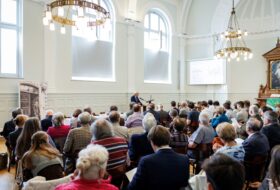
Written during the Cold War, these reflections examine, with over five decades’ hindsight, the collapse of the Danubian monarchy that had evolved since the early modern period, alongside the upheavals that shaped Europe in the 20th century. The enduring relevance of these questions was the focus of a book launch and discussion at our headquarters.
In his introduction, Director Gergely Prőhle drew a parallel between the volume and A. Wess Mitchell’s The Grand Strategy of the Habsburg Empire, recently reissued in Hungarian by Helikon. In his view, both combine experience of public life with a historical perspective. Miklós M. Nagy, who leads the publishing house, praised the author’s prose for an assurance seldom found in political commentary, while noting several observations that invite debate. Professor Michael Gehler, who heads the Institute of History at the University of Hildesheim and contributed the afterword, emphasised Otto’s holistic understanding of the past, which took account of risks and alternatives as well as favourable developments.
The panel was joined by historian István Hiller, Hungary’s former Minister of Culture and Education. They first addressed the clash between the imperial idea and the concept of universal monarchy. In Otto von Habsburg’s interpretation, the Battle of Königgrätz in 1866 marked a watershed: the medieval Reichsidee, rooted in theocracy and refined by the Habsburgs over the preceding five centuries, gave way to narrow nationalism. Otto traced the lasting consequences of this defeat through the First World War and the peace treaties that followed – which he regarded as inadequate and unjust – to the Second World War and, ultimately, the international order established at Yalta that defined the latter half of the 20th century.
In 1971, he saw European unity as the only way forward for the nations of a divided continent. The conversation turned to the statesmen and thinkers portrayed in the volume – Richard Coudenhove-Kalergi, Robert Schuman, Konrad Adenauer, Charles de Gaulle, Bruno Leoni, and Salvador de Madariaga – and their visions of a strong, united Europe, true to its own identity. The speakers also considered how far the problems of that era find echoes in today’s challenges: a geopolitical environment dictated by great-power interests, Europe’s economic competitiveness, and its lack of an independent defence capability.
Piano works by Carl Maria von Weber and Franz Schubert, performed by Máté Dömötör, provided a fitting musical accompaniment to the event.