“The struggle against totalitarianism has many unsung heroes. Otto von Habsburg is undoubtedly one of them.” Shortly before his death, Edwin J. Feulner, founder of the once-legendary Heritage Foundation and himself a leading figure in that battle, paid tribute to our namesake in these words. Arguably the foremost institution-builder in American conservatism, he was more than a distant admirer of Otto’s work. He knew at first hand the extraordinary energy, versatility, and dedication with which the archduke had served the cause of liberty for decades. This commitment encompassed high-profile political interventions, forging alliances, and the painstaking daily tasks they entailed, as well as an intellectual endeavour to defend the ideal of freedom and the values of Western civilisation. His arguments resonated far beyond the European continent, reaching influential forums of public debate in the United States. Indeed, one of his essays, held in considerable esteem across the Atlantic, was written with the assistance of the very man quoted above.
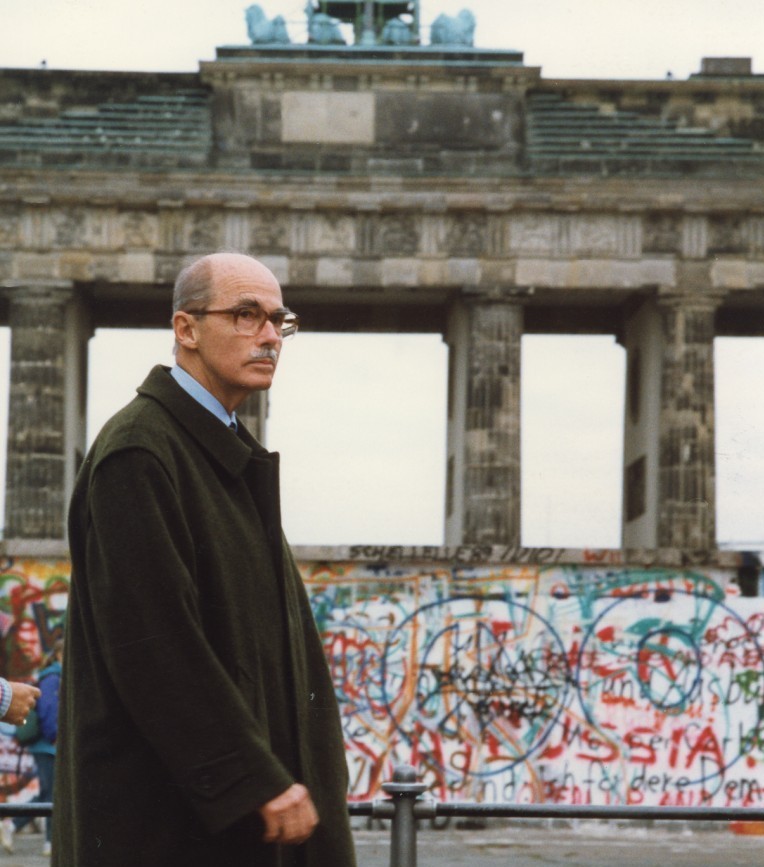
Feulner was a commanding presence. Those who met him remembered not only his stentorian voice but also his remarkable powers of persuasion, brilliant mind, and humour. Thoroughly American yet distinctly cosmopolitan, he knew Europe intimately, returning regularly from his youth onwards. There, albeit indirectly, he encountered the realities of oppression. In August 1961, as the Berlin Wall was going up, the twenty-year-old learnt for himself what the forcible restriction of movement meant: “Personally, as a college student in 1961 I had been travelling in West Germany with a group of my college classmates (and a Jesuit chaperone!). We were in Munich for my 20th birthday – 12 August 1961. The next afternoon we had planned to drive our VW minibuses on the Corridor through the DDR [East Germany] to West Berlin. Watching local television in a Munich beer hall that evening, we learned that East German and Soviet troops were massing in East Berlin. This gave us pause – that night the first barbed wire Berlin Wall was erected. We did not make the trip to Berlin that day. And, of course, the reinforced wall stood for 28 years as a grim reminder of its primary goal – to keep its people in. That Wall was a physical expression of the evils of totalitarianism, of the attempt to obliterate the will that lives in all of us to be free.”
Barely four years later, on another visit to Europe, Feulner met Otto von Habsburg for the first time. Arriving in Pöcking on 14 August 1965, he could scarcely have imagined that their early-evening encounter would mark the beginning of a relationship lasting several decades. He nevertheless came to 15 Hindenburgstraße with his characteristic cheerful confidence and two very definite purposes: to invite Otto to the next meeting of the Philadelphia Society, which espoused conservative and libertarian values, and to ask him to write a short treatise for the Intercollegiate Review, a recently launched journal closely associated with that American intellectual milieu.
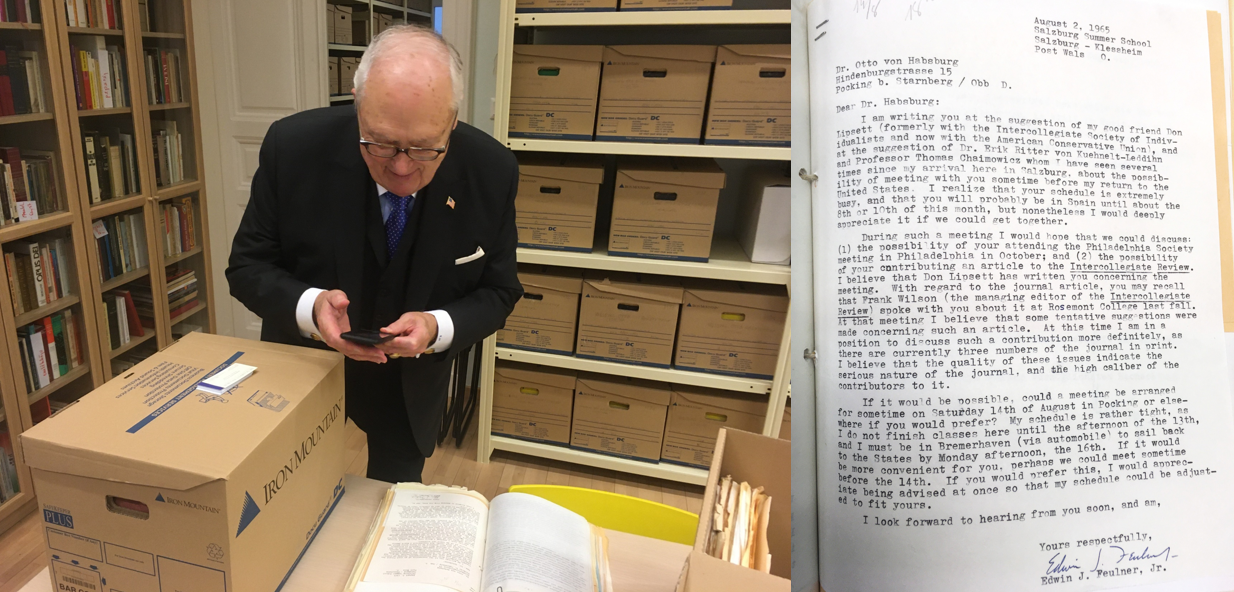
Edwin Feulner visiting our Foundation’s collection, November 2019
Although our namesake could not attend the Philadelphia Society’s gathering, the visit soon bore fruit in an article published in the September–October 1966 issue under the title “The Effects of Communism on Cultural and Psychological Politics in Eastern Europe”. It was, in essence, a think piece: an analytical essay that placed the internal contradictions of communist regimes within a broad historical and anthropological argument. At the height of the Cold War, when these systems still appeared firmly established and likely to endure, Otto asked why they would nevertheless prove incapable of surviving in the long run. The text also offers an unusually clear portrait of him as a thinker – an aspect of his character that has perhaps received less attention than it deserves. How closely this cast of mind informed the former Crown Prince’s entire public life is apparent from the words of Tom Lantos. At a meeting in 2005, the celebrated Democratic congressman credited Otto with “a Churchillian vision and statesmanship unprecedented in our time”, describing him as a man who had “fought the twin evils of Nazism and communism with the courage of his convictions and brilliance of his intellect”.
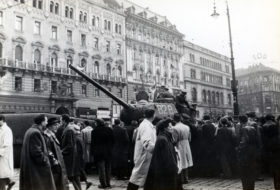
The essay itself embodies this rigour and originality. Its enthusiastic reception in the United States shows how strongly it appealed to the journal’s predominantly conservative readership. Whether by coincidence or editorial design, the carefully crafted work appeared a little over a month before the tenth anniversary of the 1956 Revolution. The timing could hardly have been more telling. Hungary had demonstrated a decade earlier precisely what Otto argued so persuasively here: even with every instrument of repression at its disposal, a communist ideology bent on total control of society could not eradicate the desire to be free.
Nor was this insight confined to a publication intended for American readers. On 23 November 1959, Otto von Habsburg delivered a lecture in Antwerp, subsequently issued in Dutch, French, and Hungarian by the Brussels-based publisher Magyar Ház. Entitled A hidegháború fordulópontján [At a Turning Point in the Cold War], it reached similar conclusions, relating the lessons of 1956 to the weak social foundations of Soviet rule: “The Hungarian uprising proved that the Soviet puppet governments lack popular support and possess not even a shadow of power.” In his interpretation, the revolt thus demonstrated that coercion could never confer legitimacy – an argument that comes close to Max Weber’s distinction between Macht and Herrschaft.
In the Intercollegiate Review, he went on to examine at length the social consequences of repression. The apparent strength of Moscow’s satellite regimes, he maintained, lay not in the persuasive appeal of Marxist-Leninist doctrine but in political domination and violence. Physical force might compel a measure of outward obedience in the socialist bloc for a time, yet it could never wholly suppress the demand for autonomy. This had implications for the system itself: by denying individuals the scope to develop their capacities, and thus to exercise the creativity repeatedly emphasised in the article, it necessarily limited its capacity for renewal and adaptation.
This leads directly to a question associated with Friedrich Hayek: can deliberate planning and targeted intervention create viable social institutions of the kind that otherwise emerge spontaneously from individual actions? Both the Nobel Prize-winning economist and Otto answered in the negative. Their reasoning also implied that communism would ultimately fall not simply for political or economic reasons, but as a result of deeper civilisational and – if you will – anthropological processes. Its most profound failure lay at the point where its power encountered an insuperable limit: human nature. The archduke reserved his prophetic conclusion for the end, giving it full rhetorical force: “The cause of this defeat, rather, must be looked for in the human psyche which, in the long run, will not tolerate shackles.”
“Did We See It Coming?” This was the question posed at a social science conference held in Budapest in late 1990 to consider the transformations in Eastern and Central Europe. The title conveyed not merely surprise but a need for self-examination. If the collapse of state socialism seemed almost inevitable in retrospect, why had the developments that brought it about gone undetected? Among the speakers was Rudolf Andorka, the doyen of contemporary Hungarian sociology and later rector of the Budapest University of Economic Sciences. He stressed the “renewed recognition of the individual’s role and freedom”, challenging the previously dominant outlook, also espoused by Marxism-Leninism, which saw history as a process governed chiefly by necessity and leaving little room for personal initiative. Against this, he asserted unequivocally that “the individual is not powerless in the face of great historical processes”. Andorka thus arrived at an understanding essential to Otto’s argument a quarter of a century before: a rejection of determinism in accounts of social change and a fresh appreciation of individual agency and responsibility.
Although the future can scarcely be predicted in detail, the direction of present developments and their longer-term consequences can sometimes be discerned. What distinguished Otto from many of his contemporaries was the faculty Russell Kirk called “political imagination”: to put it perhaps too simply, the ability to look beyond immediate events and perceive the larger patterns behind them. The archduke foresaw what few in the 1960s dared to say aloud: time was working against the communist regimes. Certainly, numerous commentators wrote about the symptoms of crisis in the various forms of “actually existing socialism” and the adjustments they would sooner or later be forced to make. Yet recognising the need for reform was quite different from acknowledging that the system itself had reached a dead end.
This prophetic insight remained with the former heir to the throne. In the early 2000s, when Vladimir Putin had only recently risen to the presidency and enjoyed considerable popularity in the West, Otto already understood the dangers inherent in the Russian leader’s policies. Where others saw an informed and engaging statesman, our namesake repeatedly cautioned that the Kremlin’s master sought to hollow out democratic institutions gradually, centralise authority, and revive Russia’s great-power ambitions.
Edwin Feulner’s recollections show how, during the Cold War, Otto’s far-sightedness and optimism provided a significant stimulus even to American political thought, with its traditional confidence in the future. The study published sixty years ago reveals much about the sources of that assurance. Ultimately, it is a hopeful manifesto of faith in freedom, expressing the conviction that history is not shaped solely by conflict, class struggle, or the clash of opposing interests and ideologies. Genuine progress comes from releasing the creative potential of liberty. Underlying his argument is a distinctively Christian (and, horribile dictu, liberal) belief in our capacity to influence the course of events, grounded in respect for the dignity and freedom of the individual. His closing observation that “the narrowness of the Communist human ideal, the stringent limitation of thought demanded by the ideology, as well as the distortion of emotional life by the party, have led to certain counterproductive effects” carries a lesson beyond the particular case of communism. It stands as a warning to any form of government that seeks to subject personal liberty to excessive control.
Bence Kocsev