“Purchasing Crockery for Their Little Highnesses”
Behind the dispute lay a happy occasion and the need to uphold the dignity of the court. On 10 March 1918, Empress and Queen Zita gave birth to her fifth child, Archduke Carl Ludwig, in Baden bei Wien. At the time, the imperial family was considering an extended stay in Hungary. With the arrival of the newborn, additional china needed to be procured both at their Austrian residence and at Buda Castle. Lina Löw,[1] the housekeeper responsible for the children’s household, placed a direct order for breakfast and dinner sets, washstand sets, and kitchenware.
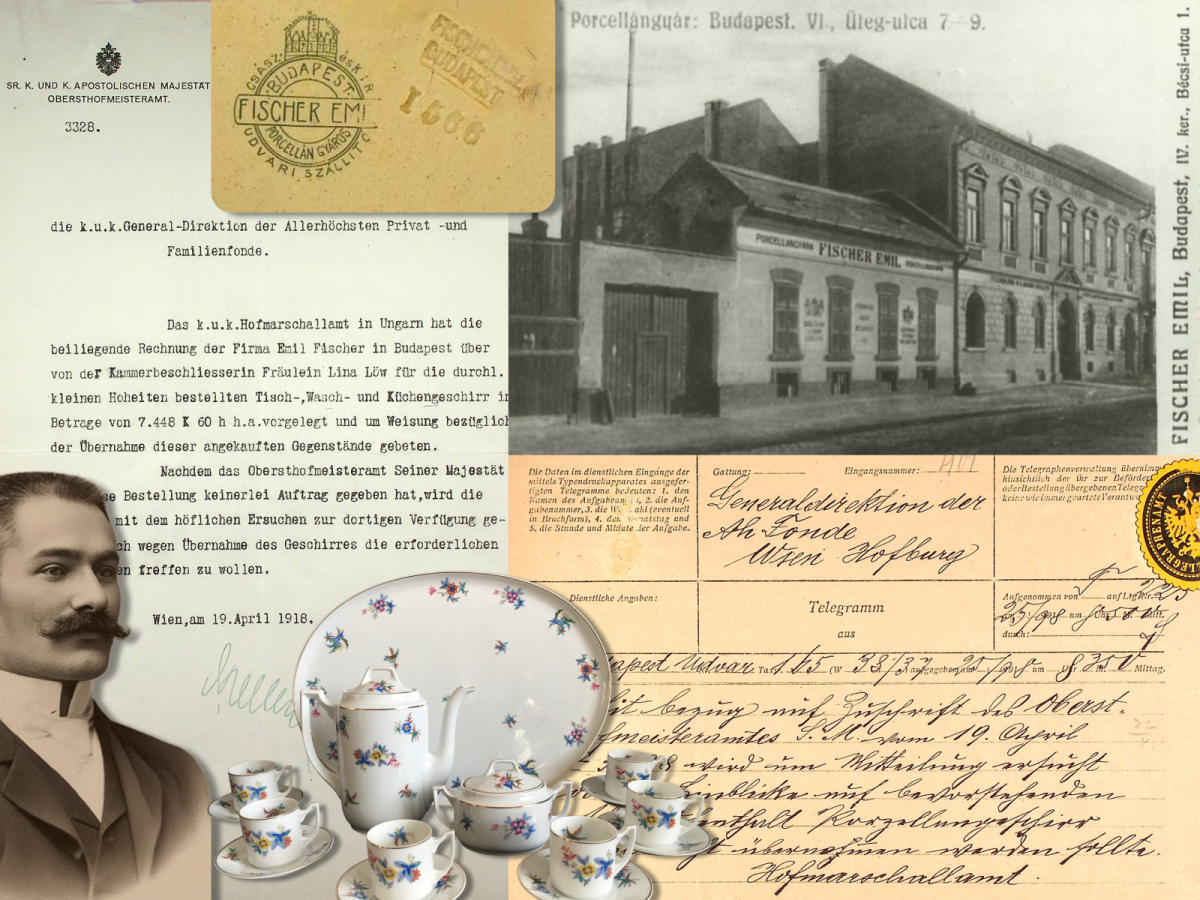
The commission went to Emil Fischer of Tóváros (1863–1937), a renowned Budapest merchant specialising in porcelain and glass who had supplied the court before. He came from a long-established family of porcelain manufacturers, and his Art Nouveau ornamental pieces and finely crafted ceramics were highly regarded in Vienna. The surviving documents do not reveal the chosen patterns or the number of place settings, but the wares had to meet courtly aesthetic standards while remaining suitable for everyday use.
A Bureaucratic Maze
After delivery, the firm submitted an invoice for 7,448 korona and 60 fillér. Amid wartime inflation and widespread shortages, this represented almost a year and a half’s earnings for a skilled factory worker and several months’ salary even for a senior ministry official.
When staff at the Office of the Lord High Steward in Vienna (Obersthofmeisteramt), which managed the imperial household, reviewed the documentation, they discovered that no prior authorisation had been issued for the purchase. In its directive no. 3328, the office refused to charge the expenditure to the state-funded court budget, arguing that providing for the emperor’s children was a private rather than a public responsibility. It recommended using the dynasty’s own resources instead and, on 26 April, referred the matter to the Directorate-General of the Supreme Private and Family Funds (Generaldirektion der allerhöchsten Privat- und Familienfonde).
Vetoes to the Bitter End
Following the April decision, the file lay dormant at the Directorate-General in Vienna for months. By autumn, however, when the empire was on the brink of disintegration, correspondence intensified between the capital and the local branches based at Buda Castle, collectively known as the “Budapest Court”. On 25 September, the Private Funds administration likewise declined to settle the bill. Under directive no. 1430, it forwarded the claim to Queen Zita’s own Lord High Steward’s Office on the grounds that the children’s upkeep should be covered by their mother’s household budget.
Meanwhile, the Court Marshal’s Office in Hungary (Hofmarschallamt in Ungarn) sent a telegram urging Vienna to act. With the royal visit approaching, the palace needed the crockery, which had to be taken into custody without delay, despite the unresolved question of responsibility.
In early October, Alajos Roth,[2] imperial and royal court councillor and superintendent of Buda Castle, had Fischer’s crates opened. On unpacking them, he found that the quality of the porcelain fell short of expectations. The types and numbers of pieces supplied also appeared to differ considerably from those specified in the invoice and the agreement.
Roth therefore withheld certification, suspended acceptance of the delivery, and telegraphed Vienna for the full particulars of the order. Upon receiving the requested details from the Queen’s office, he examined the consignment item by item and recorded the discrepancies. On 14 October 1918, he concluded his inspection and returned the file for further action.
An Account Left Open for Eternity
After months of bureaucratic wrangling, the case was overtaken by history itself. The journey to Hungary took place at the height of the political crisis. The royal couple decided to leave barely a day in advance, and their departure resembled a hasty retreat. The King hoped that his presence would calm public unrest and save his throne.
Yet on their arrival on 23 October, Charles and Zita stayed well away from Buda Castle for security reasons. With tensions at breaking point, their train bypassed Budapest, and they proceeded directly to Gödöllő Palace before returning to Vienna a few days later.
Fischer’s extravagantly expensive porcelain thus awaited the young archdukes in vain at the palace in Buda. Less than two weeks after Roth lodged his complaint, the Monarchy dissolved. With the disappearance of the old court administration, the dispute over which office should handle the payment became irrelevant. Whether Emil Fischer ever received his money is a question the archives leave unanswered.
Piroska Kocsis
[1] In November 1918, Karoline (Lina) Löw was assigned directly to Zita’s private apartments. When the Monarchy collapsed, she accompanied the deposed imperial family to the hunting lodge at Eckartsau in Lower Austria, and then into exile in Switzerland in the spring of 1919.
[2] Alajos Roth (Alois Roth) (1860–1929) served as imperial and royal superintendent of Buda Castle (K. u. k. Burghauptmann in Budapest) during the reigns of Francis Joseph I and Charles IV. He was responsible for the running of the royal palace in Buda.