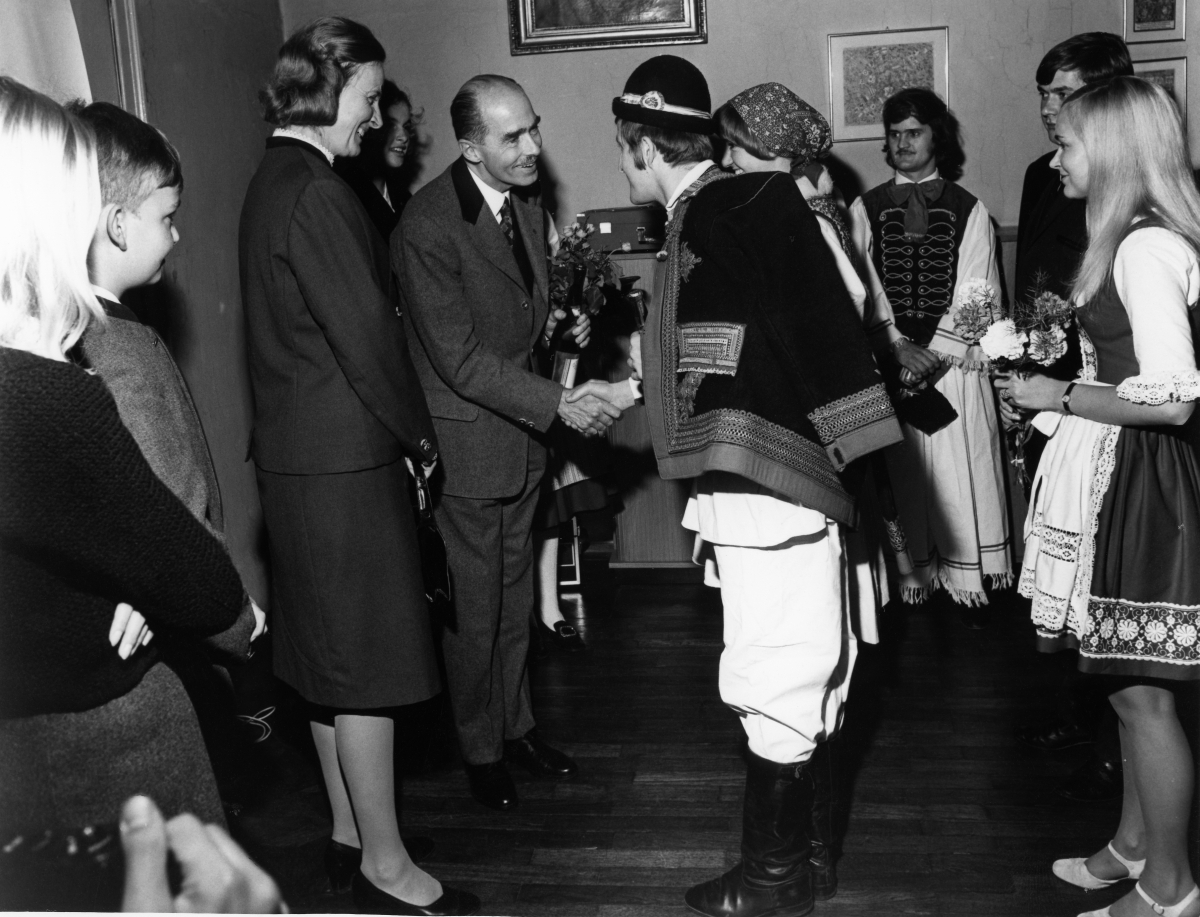
Burgenland Croats greet Otto von Habsburg on the occasion of his 60th birthday.
The double issue of Rendszerváltó Szemle [Hungarian Regime Change Studies] (vol. XI, nos 2–3), entitled Európai utas [European Traveller], appeared on 21 September. In the journal of the Research Institute and Archives for the History of the Hungarian Regime Change (RETÖRKI), our Foundation’s Deputy Director examines Otto von Habsburg’s commitment to the cohesion of the Danube Basin amid the upheavals of the 20th century.
Drawing on family tradition and his extensive knowledge of history and geopolitics, the former Crown Prince developed a clear and unwavering conception of Central Europe. He believed the Austro-Hungarian Monarchy formed a coherent whole despite its diversity and that its dismemberment had jeopardised Europe’s balance and security. He attributed German and, subsequently, Russian expansion to the emergence of mutually antagonistic countries in place of the Habsburg Empire, with borders that often defied historical logic.
From the outset of the Cold War, he regarded Soviet occupation as unnatural and its eventual end as inevitable. The events in Hungary in 1956 and Czechoslovakia in 1968 reinforced this assessment, which was ultimately vindicated by the collapse of communist regimes in 1989.
He looked to European integration guided by the principle of subsidiarity to bring the peoples of the Danube Basin together again and restore unity to the lands once under imperial rule. Although he saw no prospect of changing frontiers after 1989, he did envisage closer cooperation among the Monarchy’s successor states in the European Union.
To the end of his life, he maintained that Central Europe – which he referred to as the Danube Basin – was a distinct community within the continent. He personally sought to preserve and strengthen it and urged national political leaders of its constituent countries to do likewise. The article sets out the broader context of this consistent outlook and can be read in Hungarian below.