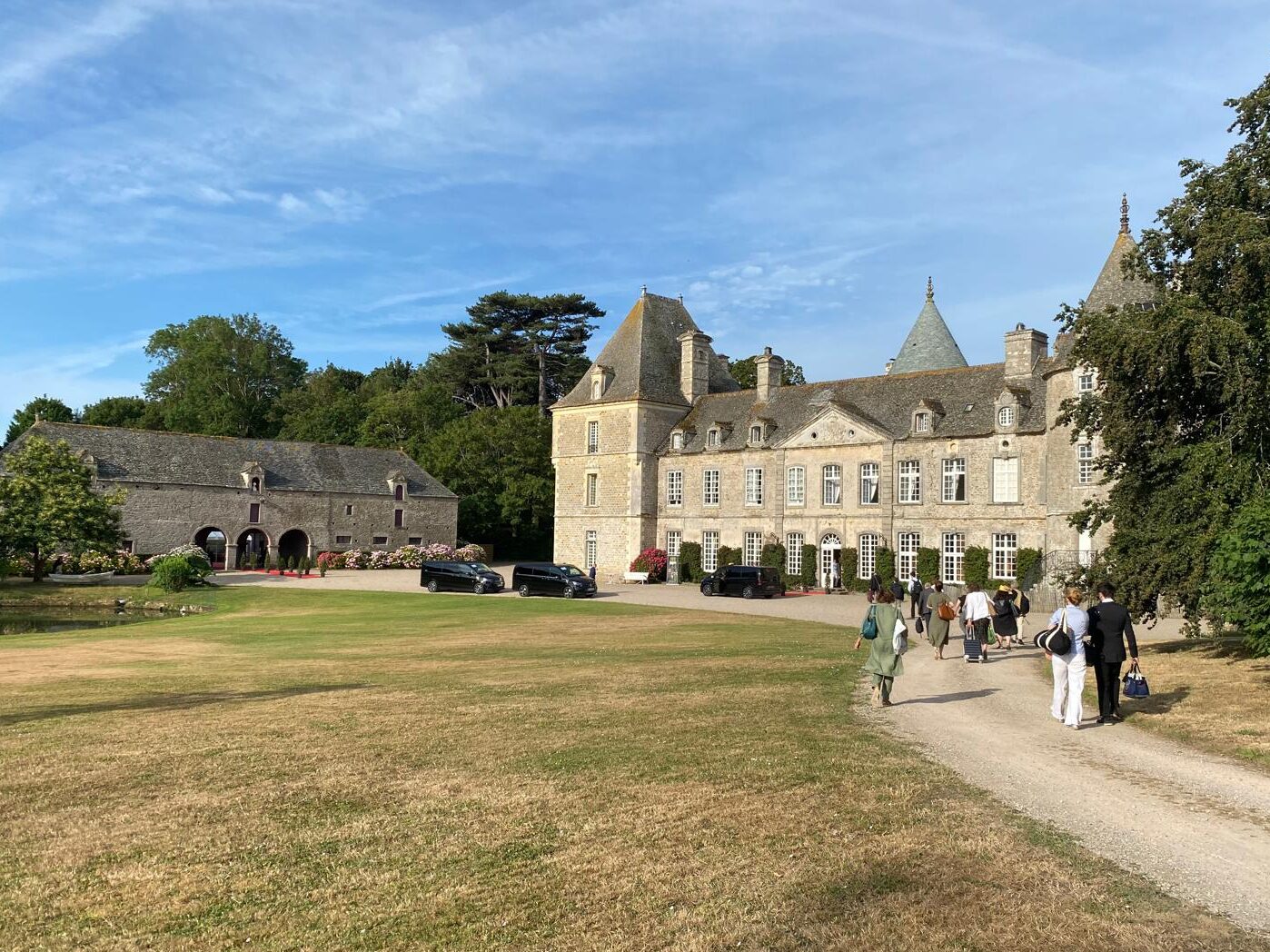
The intellectual legacy of Alexis de Tocqueville (1805–1859) is renowned worldwide. His reflections on democracy and political liberty have lost none of their relevance. The French count, historian, writer, philosopher, academician, and statesman left behind a remarkably rich body of work, which has also been a central topic at one of the Otto von Habsburg Foundation’s conferences. Otto von Habsburg frequently cited Tocqueville’s writings and repeatedly emphasised their enduring significance, noting that “few works inspired by contemporary political circumstances have withstood the test of time so successfully or have been so thoroughly vindicated by subsequent events as the writings of Alexis de Tocqueville.”[1]
The memory of the great thinker survives not only in his books but also in stone. His family château, originally built in the sixteenth century and remodelled several times over the centuries, has been preserved for future generations thanks to the dedication of his descendants. In 2018, Count Jean-Guillaume de Tocqueville d’Hérouville and his wife, Stéphanie de Tocqueville – granddaughter of Jacques de Lalaing, the Belgian ambassador to Budapest between 1935 and 1941 – launched the initiative known as the Tocqueville Conversations. The two-day conference is organised annually around a selected theme, explored through lectures, roundtable discussions, and informal exchanges of ideas. The programme is largely made possible through the work of the French-American Tocqueville Foundation, established in 2012 and chaired by Count Jean-Guillaume de Tocqueville. Another key partner is the French daily Le Figaro, particularly through the involvement of journalist Laure Mandeville.
This year’s meeting, held on 26–27 June 2026, focused on the future of democracy. The theme resonated naturally with the 250th anniversary of the United States Declaration of Independence, one of the foundational documents in the modern history of liberty and self-government. Tocqueville’s two-volume masterpiece Democracy in America provided an obvious point of departure, yet the discussions quickly moved beyond historical reflection. Around fifty speakers addressed contemporary crises, transatlantic relations, possible political responses, and the challenges facing France ahead of its 2027 presidential election.
The distinguished list of participants reflected the importance of the event. Leading public figures and scholars from both Europe and North America offered their perspectives on democracy from a wide range of viewpoints. Among them were Boualem Sansal, the French-Algerian academician; former French Prime Ministers Manuel Valls and Bernard Cazeneuve; former Italian Prime Minister Enrico Letta; Members of the European Parliament Sarah Knafo and François-Xavier Bellamy; Professors Joshua Mitchell (Georgetown University) and Eliot A. Cohen (Johns Hopkins University); former Lithuanian Foreign Minister Gabrielius Landsbergis; former Ukrainian Ambassador to Austria Olexander Scherba; Camille Grand, Secretary General of ASD, the Aerospace, Security and Defence Industries Association of Europe; and former Spanish Foreign Minister Ana Palacio.
More significant than the distinguished names, however, was the atmosphere in which the debates took place. The participants often represented markedly different political and intellectual perspectives, yet they engaged one another in substantive, respectful, and genuinely constructive dialogue. At the same time, the discussions clearly revealed the differing emphases that currently characterise debates on the two sides of the Atlantic.
Marking the “USA 250” anniversary, the Otto von Habsburg Foundation is likewise dedicating this year’s programmes to the study of European-American relations. Against this background, the conference provided an excellent opportunity to strengthen ties with both the Tocqueville Foundation and the Tocqueville family. We are honoured that Count Jean-Guillaume de Tocqueville has accepted our invitation to speak at the Foundation’s conference on 20 November, an especially meaningful occasion given the profound importance that Alexis de Tocqueville’s thought held for our namesake, Otto von Habsburg.
This invitation builds upon an already established relationship. Two members of our Board of Trustees, György Károlyi and György Habsburg, previously attended the Normandy forum during their diplomatic service as ambassadors, as did our Deputy Director, Gergely Fejérdy. The Foundation’s participation on 26–27 June therefore represented not merely a protocol visit but the strengthening of an existing professional partnership.
During the meeting, Count Jean-Guillaume de Tocqueville and his wife expressed their sincere admiration for Otto von Habsburg and their deep appreciation of his intellectual and political legacy. They also welcomed the Foundation’s commitment to preserving and promoting this heritage. Beyond the hosts, several other participants expressed considerable interest in the Foundation’s activities and indicated that they would welcome the opportunity to visit Hungary for one of our future events.
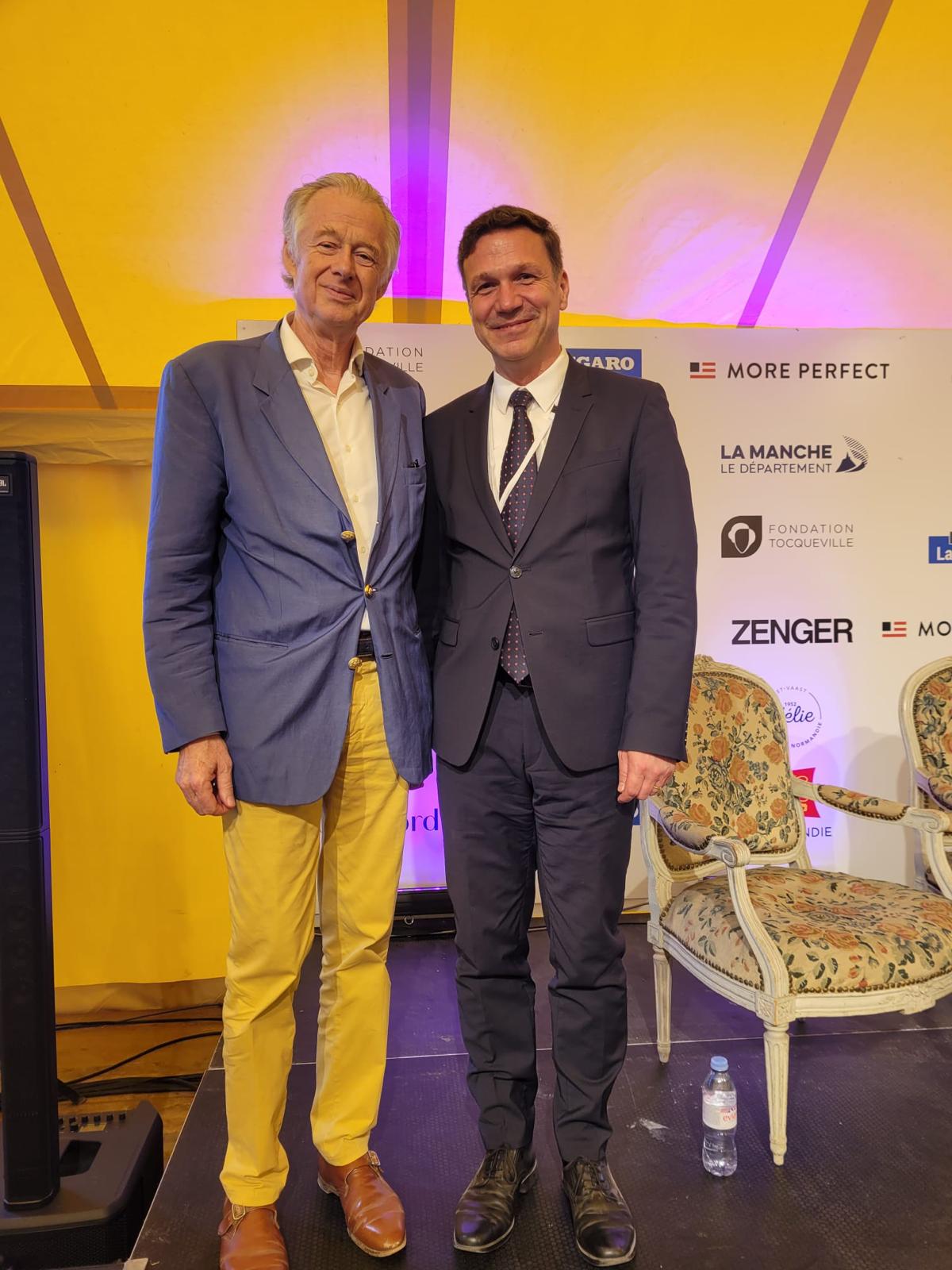
Former Italian Green Member of the European Parliament Monica Frassoni also shared personal recollections. Earlier in her career, while serving as a parliamentary assistant, she had met Otto von Habsburg on several occasions and closely followed his work in the European Parliament. Although she did not always share the political views of the Bavarian CSU politician, she recalled being deeply impressed by his modesty, openness, extraordinary work ethic, and exceptional intellectual abilities.
The parallel consideration of Alexis de Tocqueville and Otto von Habsburg is made timely not only by the 250th anniversary of American independence. Their shared concern for democracy, Christian-inspired political thought, and dialogue between Europe and North America reveals striking intellectual affinities. The Normandy gathering therefore marked not the conclusion but rather the beginning of a professional dialogue that has the potential to further strengthen both European cooperation and transatlantic relations.
[1] Otto von Habsburg: Yalta and What Followed. Selected Articles and Studies. Munich: Griff, 1979, p. 55.