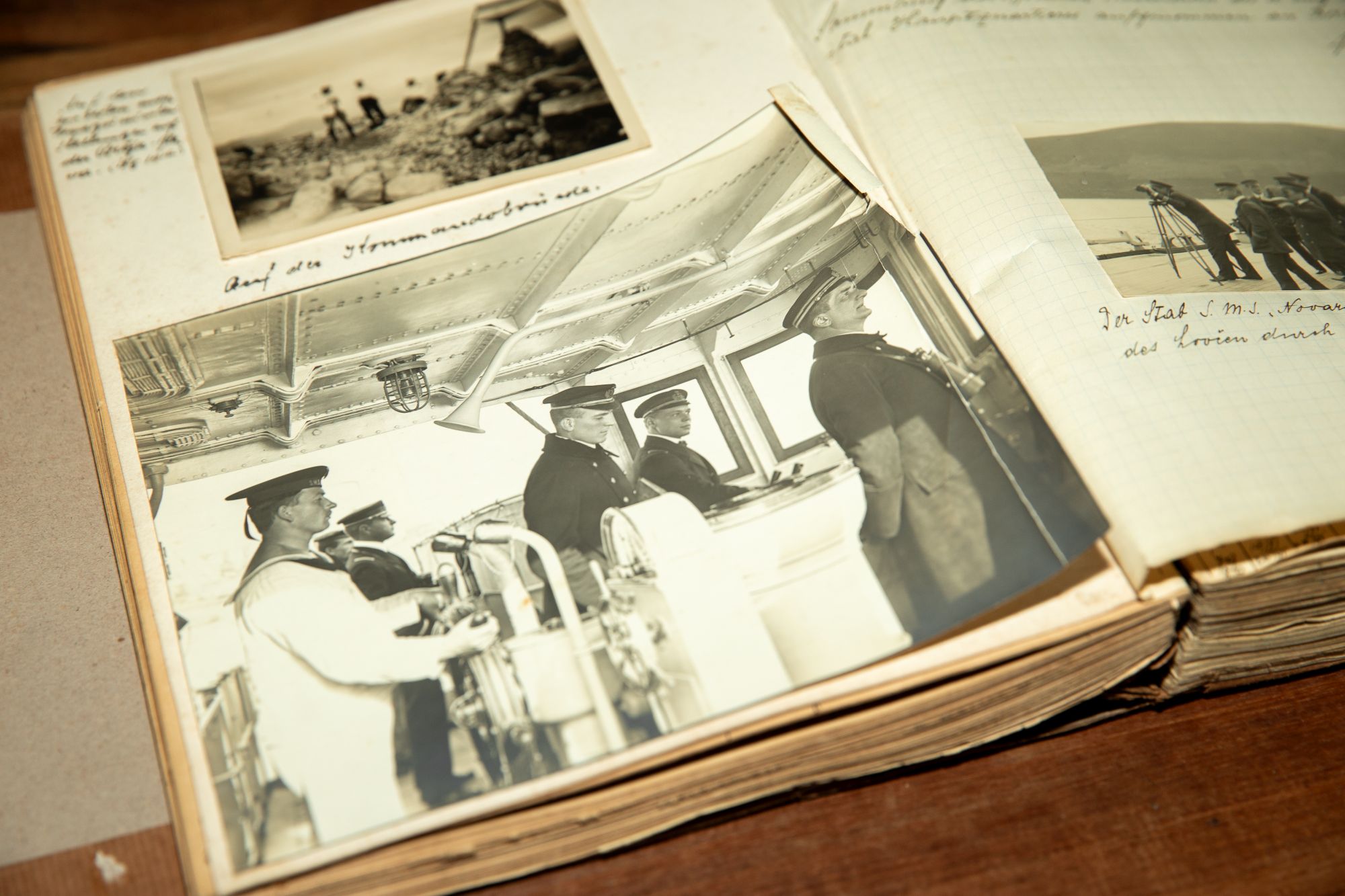
On the bridge of the Novara: Miklós Horthy and the officers on duty, including Stanislaus Witkowski (second from the right).
On 15 May 1917, the navy of the Austro-Hungarian Monarchy launched a daring attack at the Strait of Otranto. Under the command of Miklós Horthy, the light cruisers Novara, Saida and Helgoland broke through the Allied naval blockade and inflicted heavy losses on enemy vessels. The engagement, later known as the Battle of the Strait of Otranto, became the most celebrated and successful operation of the Monarchy’s navy and brought Horthy national fame.
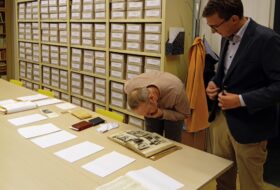
For this reason, the ship’s logbook now held in the collection of the Otto von Habsburg Foundation is of exceptional historical importance. The document not only records the daily life aboard the Novara, but also preserves a first-hand account of the events of the Battle of Otranto. No other naval source from the twentieth century of comparable detail and authenticity is currently known.
In the years preceding the First World War, Europe witnessed a major naval arms race. In 1911, following Italian naval developments, the Austro-Hungarian Monarchy embarked on a programme of fleet modernisation. As part of this effort, the Imperial and Royal War Navy developed one of the fastest and most advanced classes of cruisers of its time, consisting of three ships, among them the light cruiser Novara. The vessel was built by the Hungarian Ganz and Co. Danubius Shipyard and entered service in January 1915. Modern, swift and heavily armed, the cruiser later became renowned as Miklós Horthy’s flagship.
The ship’s logbook discovered in our collection, bearing the title Bord-Buch, originates from aboard the Novara. It contains a total of 1,280 daily entries covering the period from 23 May 1915 to 31 October 1918, arranged into chapters. Alongside the written records, the volume also includes photographs, later annotations and other supplementary texts. The entries are written in German, Italian and, in some places, English.
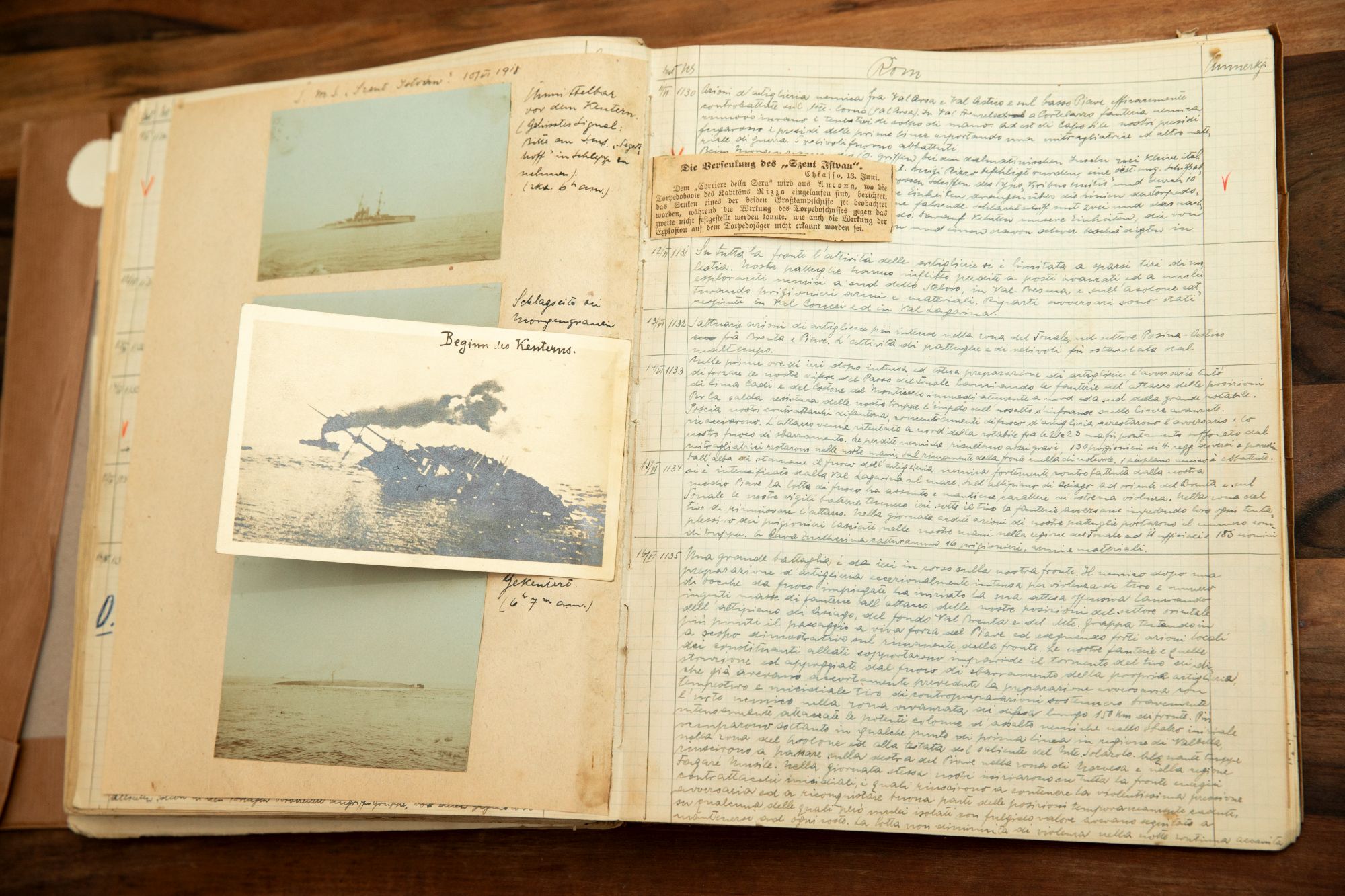
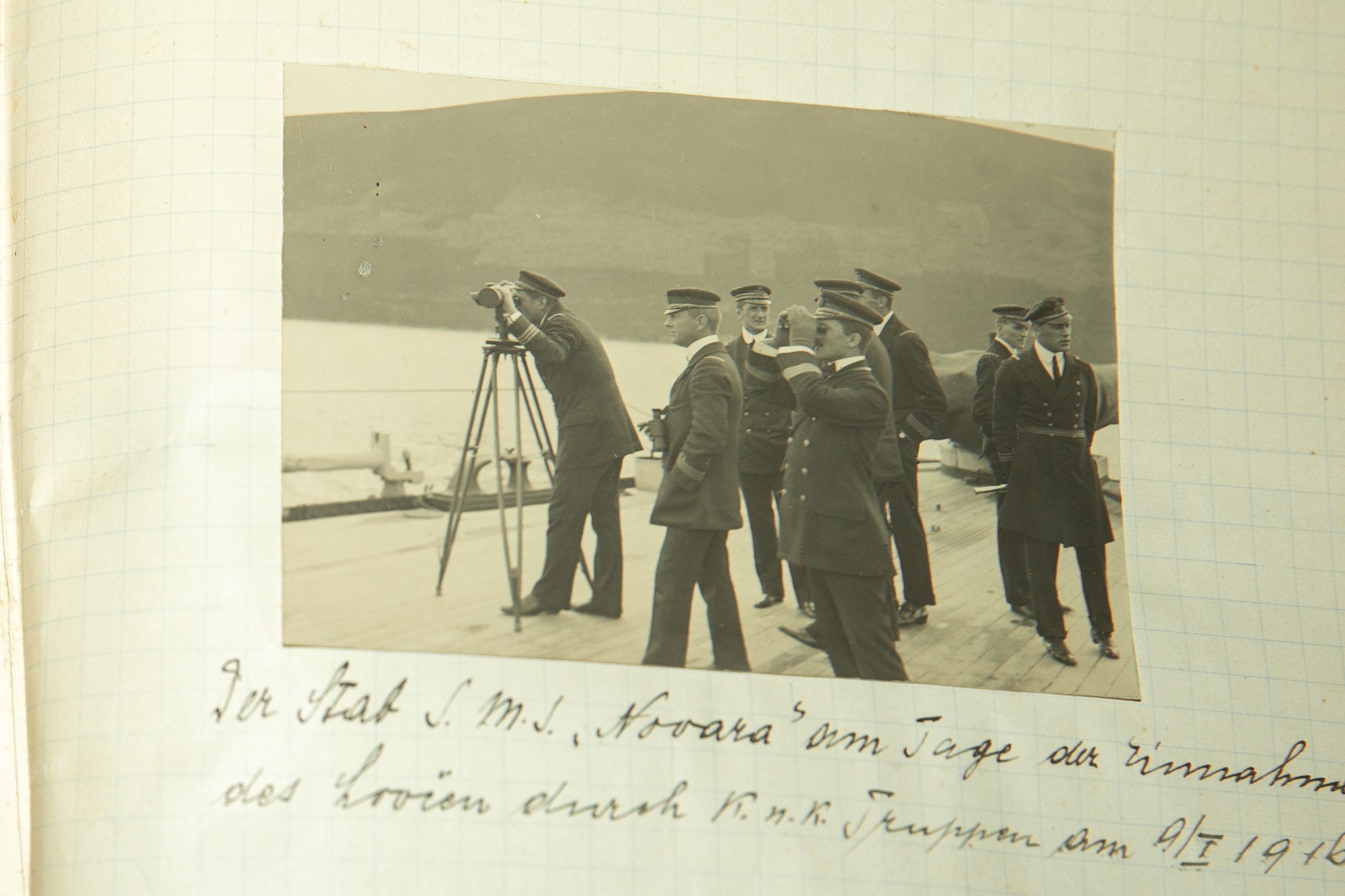
Upper image: 10 June 1918, the sinking of the battleship Szent István.
Lower image: 9 January 1916, officers of the Novara, with Witkowski visible wearing binoculars around his neck.
The first chapter covers events between 23 May and 21 December 1915. Here the identity of the author is also revealed: “Collection of official reports recorded aboard SMS Novara,” writes Stanislaus Witkowski, authenticating the entry with his signature.
Witkowski served under the command of Miklós Horthy aboard the Novara as an artillery officer. During the Battle of Otranto, after Horthy was wounded and lost consciousness, and Corvette Captain Róbert Szuborits was killed in action, Witkowski assumed command of the ship.
The second chapter records events between 22 December 1915 and 29 November 1916. During this period, the logbook primarily details reconnaissance missions against Durazzo, Manfredonia and the southern Adriatic, as well as the pursuit of an enemy cruiser.
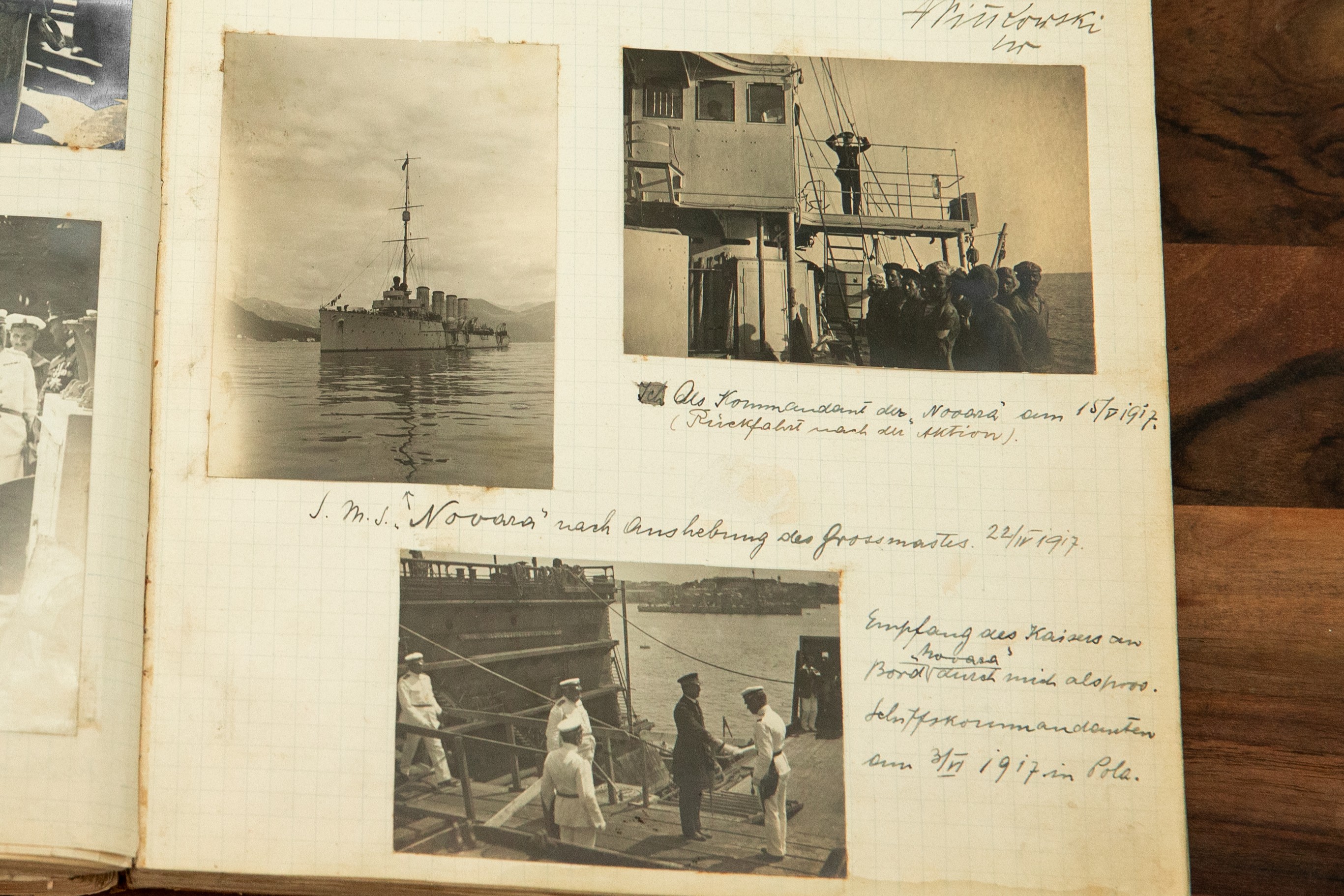
Photographs taken aboard the Novara between 22 April and 3 June 1917. Witkowski is seen giving a briefing.
The most valuable section of the logbook is the third chapter (30 November 1916 – 21 December 1917), which contains accounts of the Battle of Otranto on 15 May 1917 and the subsequent visit of Emperor and King Charles. The chapter opens with a photograph showing Witkowski briefing the crew on the morning of the battle.
This extraordinary historical source includes the operational log from the day itself, precisely documenting the cruiser’s movements, weather conditions, enemy reactions and the activities of accompanying vessels. Particularly rare are the original aerial photographs recording the events of the battle with minute-by-minute accuracy: the first image was taken at 9:40 a.m., and the last at 12:30 p.m.
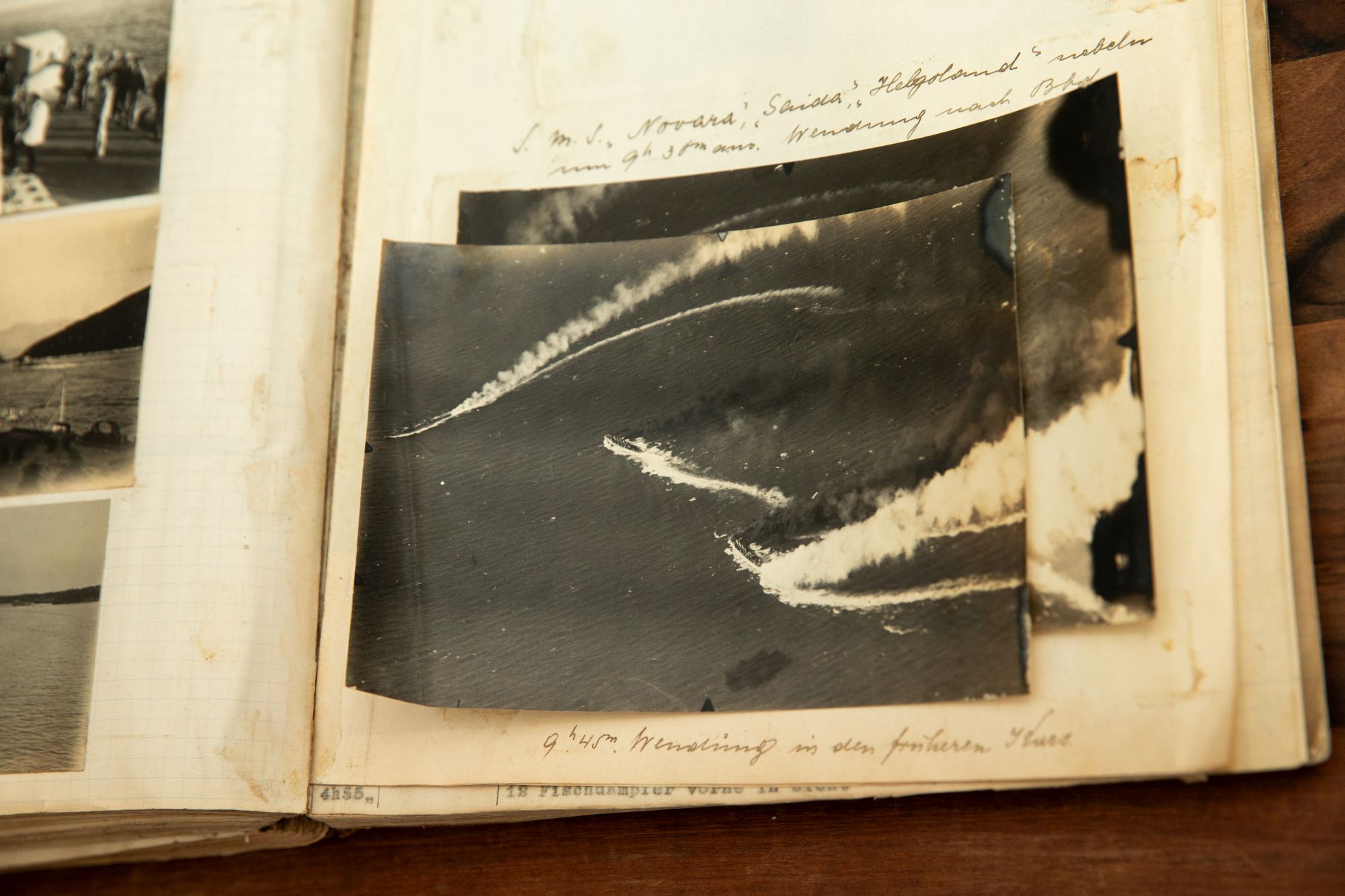
Aerial photographs of the Battle of the Strait of Otranto
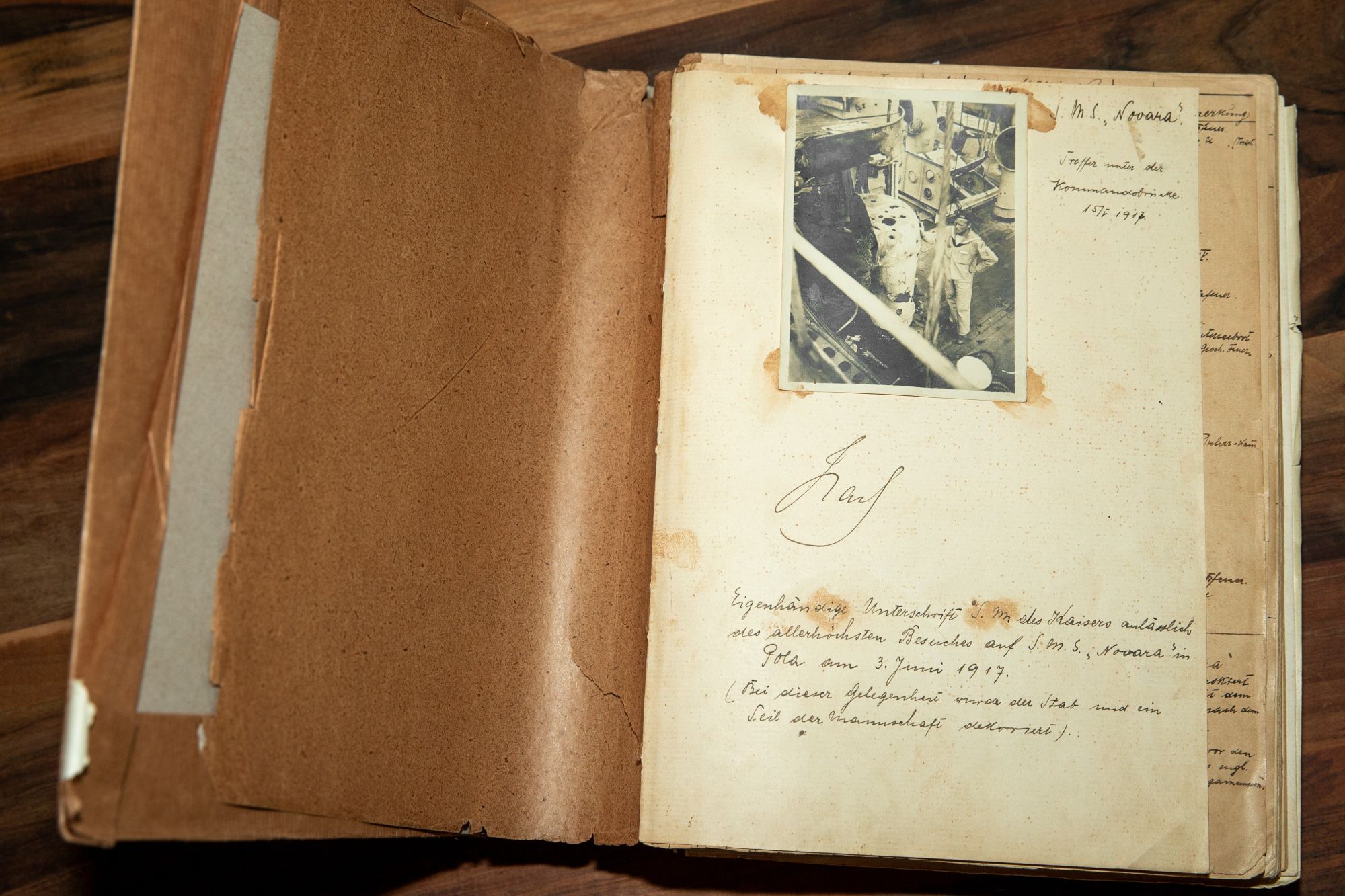
The very first page of the logbook also contains a photograph taken that same day in Pola, depicting the aftermath of the battle. In June 1917, Emperor and King Charles personally visited the Novara accompanied by Admiral Maximilian Njegovan and his aide-de-camp Zdenko Lobkowitz. The Emperor decorated the ship’s command staff and signed the logbook in his own hand. The following inscription appears in the volume:
“Signature of His Majesty the Emperor during his visit to Pola on 3 June 1917. On this occasion, the commander received a decoration.”
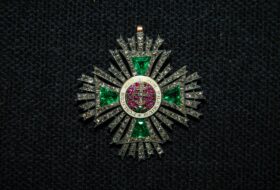
Following the official ceremony, Charles I accepted the cruiser’s cap badge and pinned it onto his own uniform. Both the visit and this symbolic gesture demonstrate the importance contemporaries already attached to the Otranto operation.
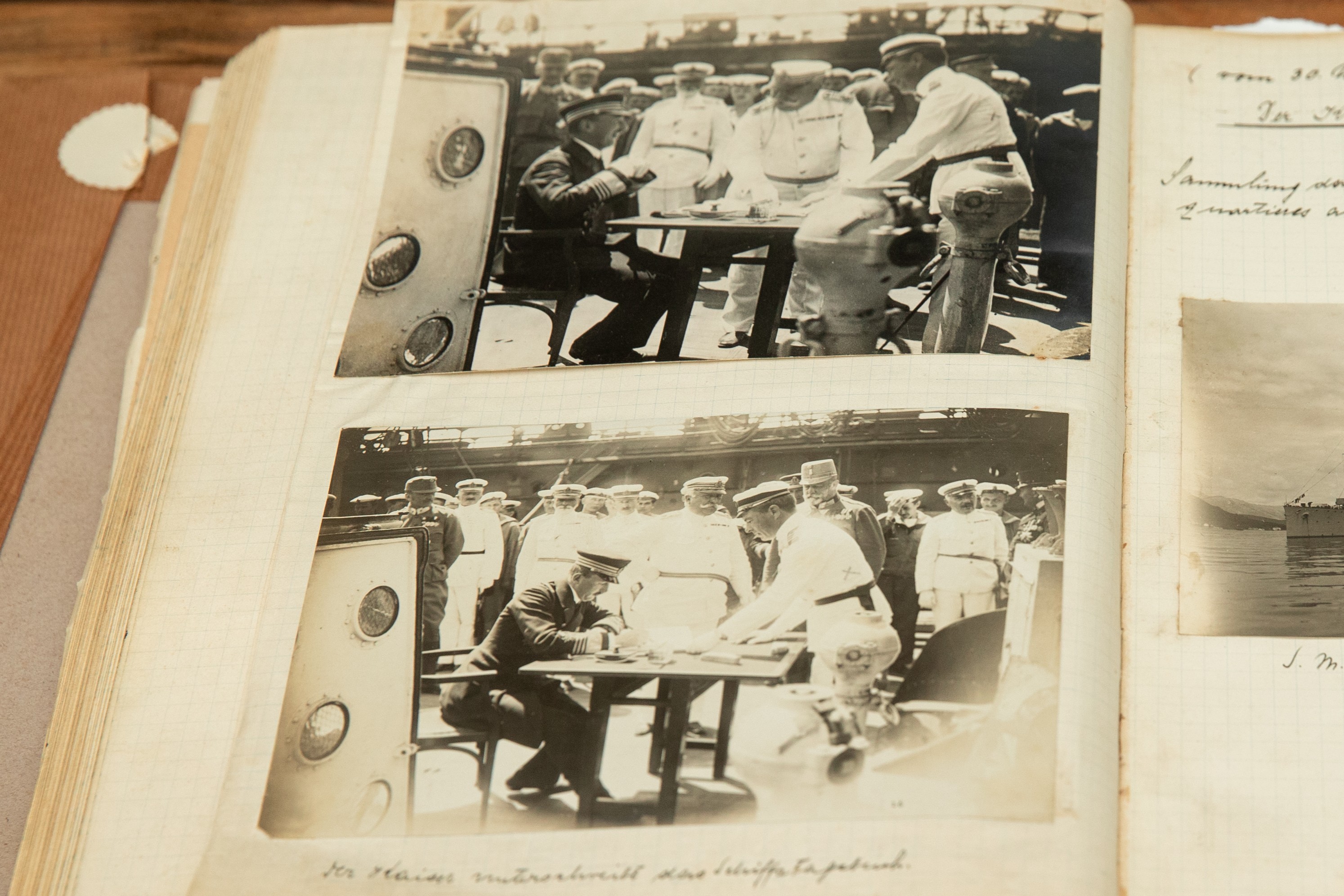
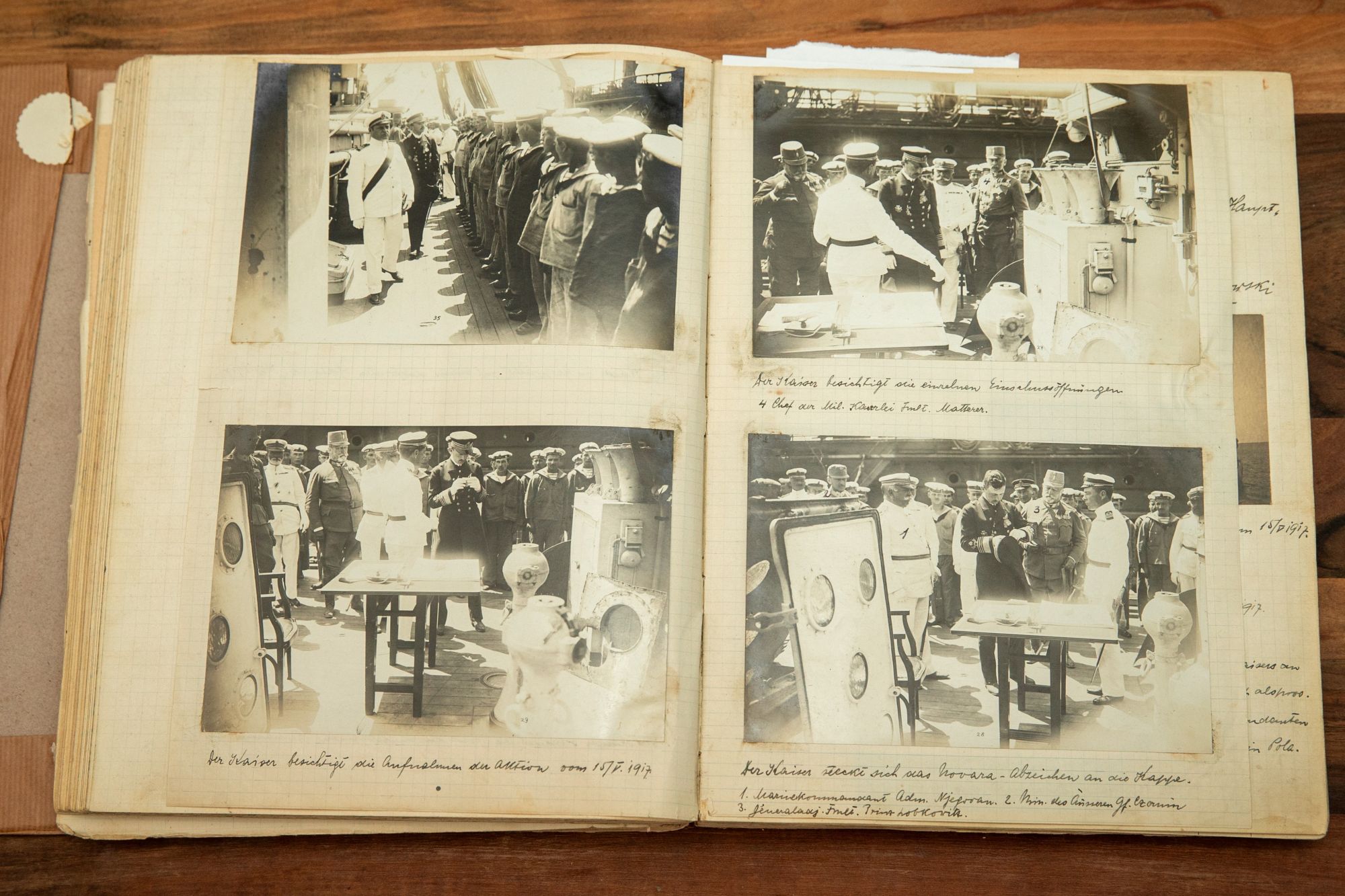
Upper image: Charles I signing Witkowski’s logbook.
Middle image: The first page of the logbook depicting the aftermath of the Battle of Otranto and the signature of Charles I. Pola, 3 June 1917.
Lower image: Charles I pinning on the Novara cap badge in the presence of Maximilian Njegovan, Zdenko Lobkowitz and Stanislaus Witkowski.
On 1 November 1917, Witkowski was promoted to Corvette Captain and appointed commander of the destroyer Velebit. His wartime career remained eventful: on 10 June 1918, he witnessed the tragic final hours of the Austro-Hungarian battleship SMS Szent István, sunk by Italian torpedoes.
In the fourth and final chapter of the logbook (22 December 1917 – 31 October 1918), Witkowski therefore records not only the activities of the Novara, but also mentions the destroyer SMS Ulan and the Habsburg-class pre-dreadnought battleship SMS Árpád. The source concludes on 31 October 1918, listing in detail which victorious powers assumed control of the individual ships of the Monarchy’s fleet after the end of the war.
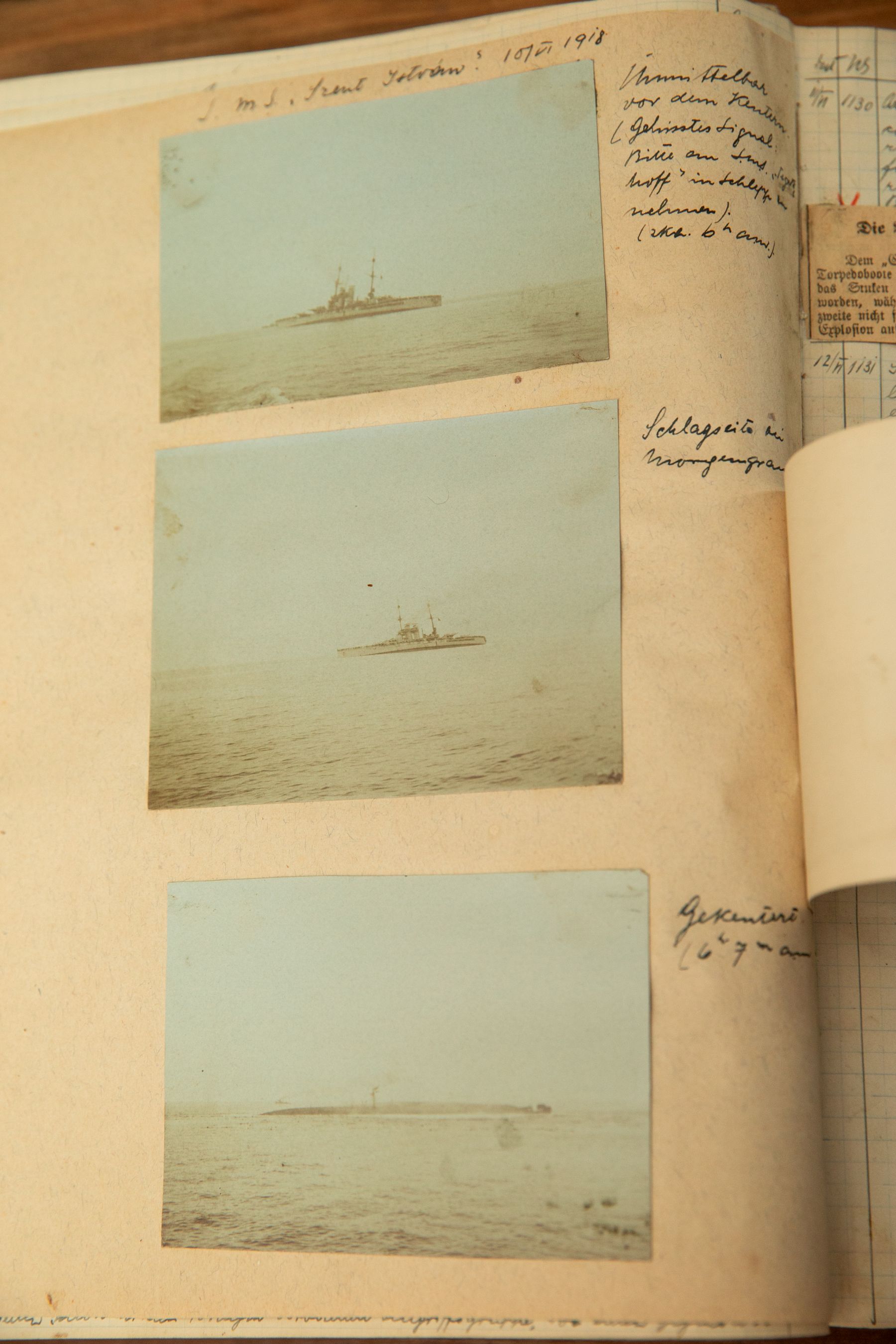
The final hours of the battleship SMS Szent István, 10 June 1918.
More than seventy photographs survive in the logbook, taken during major operations. Among them are aerial images, photographs of sunken enemy ships, direct hits, the battle-damaged cruiser Novara following the Battle of the Strait of Otranto, Horthy and Witkowski in conversation, and four photographs documenting the sinking of the SMS Szent István.
For Otto von Habsburg, the memory of the Imperial and Royal War Navy formed part of the broader monarchical tradition that he upheld and represented throughout his life. As the son and lawful heir of Emperor and King Charles, any restoration or accession to the throne would have made him the supreme patron and commander-in-chief of the armed forces, including the navy.
He maintained contact with several former naval officers who shared their recollections with him through letters and personal meetings. Among them was Lieutenant Commander Géza Paksy, who corresponded with Otto in 1961. After the war, Paksy operated a driving school in Pécs before joining the Spanish Foreign Legion. He later planned to establish an airline in West Africa, though these ambitions were thwarted by the emerging Spanish–Moroccan conflict.
Equally significant was the extensive correspondence between the Crown Prince and Lieutenant Commander Gottfried von Banfield — the last surviving member of the Military Order of Maria Theresa — which continued between 1970 and 1984 and eventually led to a personal meeting. Their conversations repeatedly returned to Trieste, Doberdò and other wartime sites of memory, as well as the naval history of the Monarchy.
During his time in the United States, Otto also received several letters from one of the Monarchy’s most famous naval officers, Corvette Captain Georg von Trapp, and his wife Maria von Trapp, who had likewise emigrated to America. Their names are familiar to wider audiences through the world-famous musical and film The Sound of Music, based on the story of the Trapp family. (We discuss the relationship between the Habsburg family and the Trapps in greater detail in another article.) Georg von Trapp, however, was renowned not only as a family man, but also as one of the Austro-Hungarian Navy’s most successful submarine commanders. During the First World War he had an outstanding military career, sinking eleven merchant ships, a French armoured cruiser and an Italian submarine. As a result, he was promoted to Corvette Captain on 1 May 1918 and appointed commander of the naval base at Cattaro. In 1924 he received the Knight’s Cross of the Military Order of Maria Theresa. Otto always regarded him as loyal and dependable, and in 1940 he visited him personally in Pennsylvania.
But it wasn’t just officers from his own country who sought out Otto; foreign naval officers did as well. In 1959, the Italian Rear Admiral Adalberto Mariano exchanged letters with the Crown Prince concerning the Monarchist Union. Mariano had fought in both world wars. During the First World War he qualified as an airship pilot before serving as an officer aboard both battleships and submarines.
Otto von Habsburg consistently paid special attention to former military officers who had served the dynasty. Beyond keeping himself informed about veterans’ associations and their activities, he also ensured that, even when unable to attend in person, he accompanied former subjects of the Monarchy on their final journey through messages of condolence.
Ádám Suslik